Skip to content

Leadership in transformation

Developing a leadership system

Designing a leadership system that works across roles and hierarchy levels.

Developing a leadership system
  • Siemens
  • Porsche
  • Bayer
  • BASF
  • Henkel
  • Sony
  • Metro Group
  • McDonald’s
  • E.ON
  • Dräger
  • Sennheiser
  • Schüco
  • WIKA
  • Currenta

At transformis, we see leadership as an organisational capability. A leadership system connects the different roles and forums where direction is set, decisions are prepared and responsibility is taken.

What you come away with

  • A shared understanding of leadership tasks
  • Aligned committees, roles and decision routines
  • Linking the leadership system with individual development

How we work

  1. 01

    Clarify the leadership task

    Identify strategic and operational decisions and conflicting goals.

  2. 02

    Design roles

    Define accountability and cross-departmental collaboration.

  3. 03

    Test routines

    Use communication and decision formats in day-to-day work.

  4. 04

    Check impact

    Check whether new perspectives actually shape decisions.

Identifying where joint decisions are needed

Which questions can individual managers handle alone, and which need several functions working together? Looking at real decisions reveals information needs, dependencies and conflicting goals.

Combining expertise and mandate

The right committees and communication formats bring relevant perspectives together. At the same time, mandates and responsibilities must be unambiguous. Leadership teams work on both the task itself and the way they work together.

Leadership also happens in the routines an organisation uses to turn new information into decisions.

Grounding leadership development in real tasks

Coaching and learning architectures complement our work on the leadership system. Individual development is linked to what each role requires. New routines are tested and reviewed together so that the organisation can continue them on its own later.

Book an initial call

Seeing leadership as a capability spread across the organisation

Leadership means observing and working with the relevant environments. Established routines can lead an organisation to screen out new expectations. Leadership has to ensure that outside perspectives get in and are processed in decisions. This does not concern individual leaders alone. Communication structures, decision paths and internal rules of the game shape what can be discussed at all.

Read more

With the top management team, we examine which tasks are decided at which level, how dissent becomes possible and how knowledge from customer contact and operations flows in. This explicitly includes non-hierarchical communication, without dissolving the formal hierarchy. A leadership system must therefore combine clear responsibility with factual, cross-functional problem-solving.

Making roles, routines and paradoxes concrete

Leadership moves between stability and change, closeness to the business and distance for new perspectives. The figure of “fence-riding” stands for people or routines that carry experience from outside into the organisation and question established patterns.

Read more

We translate the image into concrete leadership work: Where are divergent observations heard? Who decides in the event of conflicting goals? Which meetings serve to inform, and which serve a real decision? Together with those responsible, we design roles and formats in which cross-cutting questions are addressed. A published case study from an infrastructure group links the leadership system and strategy implementation; its project results remain within that case. The effect of the new system is assessed by decisions and collaboration, not by the number of new committees.

Paradoxien als dauerhafte Führungsaufgabe bearbeiten: Führung und Organisation müssen häufig gleichzeitig gegensätzliche Anforderungen bearbeiten: Stabilität und Veränderung, Exploitation und Exploration, Orientierung und Offenheit. Paradoxien lassen sich deshalb nicht durch eine einmalige Entscheidung auflösen; sie müssen beobachtet, benannt und in der jeweiligen Situation bearbeitet werden. Das schafft einen Rahmen, in dem unterschiedliche Anforderungen koordiniert werden können.

Sechs Aufgabenfelder gemeinsam im Blick halten: Das Führungsrad verbindet Strategieentwicklung, Marketing, Ressourcenmanagement, Organisationsentwicklung, Personalmanagement und Controlling. Führung richtet die Organisation damit auf künftige Entwicklungen, Kundenanforderungen, verfügbare Ressourcen und geeignete Strukturen aus. Dazu gehört eine nachvollziehbare Beobachtung der eigenen Leistung. Die Felder dienen als Reflexionsrahmen für das Führungssystem.

Arbeitsergebnisse: Gemeinsames Verständnis der Führungsaufgaben; Abgestimmte Gremien, Rollen und Entscheidungsroutinen; Verbindung von Führungssystem und individueller Entwicklung.

The brief includes leadership itself as part of the organisation. It needs a mandate to genuinely examine the relevant roles and collaboration.

Leadership is work at the boundary between the organisation and its relevant environments. The image of fence-riding makes it understandable why new information is often unsettling: someone who successfully organises a familiar process may initially experience a divergent signal as a disruption. A leadership system must nevertheless be able to take in and examine such signals. This requires clear roles, but also places for factual communication across hierarchies. Explicitly included is the design of communication structures, rules of interaction and non-hierarchical problem-solving processes.

Using concrete leadership cases, we examine where responsibility is unclear, which decision is going round in circles and which perspective has so far been missing. A new meeting structure is only helpful if it enables a better decision or better coordination. Managers must also distinguish between managing what exists and working on change. Both are part of the system.

The result can be a clarified sequence of preparation, decision, implementation and review. Its effect shows in the organisation's actions: Are conflicting goals voiced earlier, responsibilities understood and external expectations processed better?

Leadership is also work on orientation and on the performance of existing processes. Not every disruption calls for a reorganisation. Some need a clear decision, others a new opportunity for cross-departmental learning. We distinguish between these cases together with the managers. A leadership system should show where operational responsibility lies and when an issue must be decided jointly because of its strategic or organisation-wide impact. The experience from such decisions feeds into the next leadership round.

Observing the relevant environments is a leadership task. Information from customer contact, the market and operations must find its way into the strategic discussion. To this end, we examine concrete decisions to see where observations have so far got stuck: at hierarchical boundaries, in specialist departments or in meetings without a decision-making mandate. Leadership teams can enable factual communication across these boundaries while still keeping formal responsibility clear.

The image of fence-riding refers to people and formats that combine inside and outside perspectives. Based on this diagnosis, roles, committees and routines are designed so that dissent can be dealt with. The result is to be judged by the quality and implementation of real decisions, not by a new drawing of the leadership system.


Frequently asked questions

What does a leadership system include?

Roles, accountability, communication channels and recurring decisions. At transformis, we see leadership as an organisational capability: a leadership system connects the roles and forums where direction is set, decisions are prepared and responsibility is taken. The leadership wheel, with six task areas, serves as a framework for reflection: strategy development, marketing, resource management, organisational development, HR management and controlling.

Does hierarchy have to go?

No. We distinguish between cross-functional communication about the task and the formal hierarchy. With top management, we look at which tasks are decided at which level, how people can voice disagreement and how knowledge from customer contact and operations gets in. This means communication free of hierarchy without dismantling the formal hierarchy; clear accountability and practical problem-solving go hand in hand.

Why do outside perspectives matter?

They can reveal expectations and changes that established routines overlook. Leadership means observing and responding to the relevant environments; well-worn routines can lead an organisation to filter out new expectations. The boundary spanner (“Zaunreiten” in German) stands for people or routines that bring in outside experience and challenge established patterns.

How is the system reviewed?

By looking at real decisions, conflicts and collaboration across departments, not at the number of new committees. We ask: where are dissenting observations heard, who decides when objectives conflict, which meetings are for information and which for real decisions? In the DVVision programme of an infrastructure group, formats for managers, feedback and decisions at group and topic level are documented.

In practice

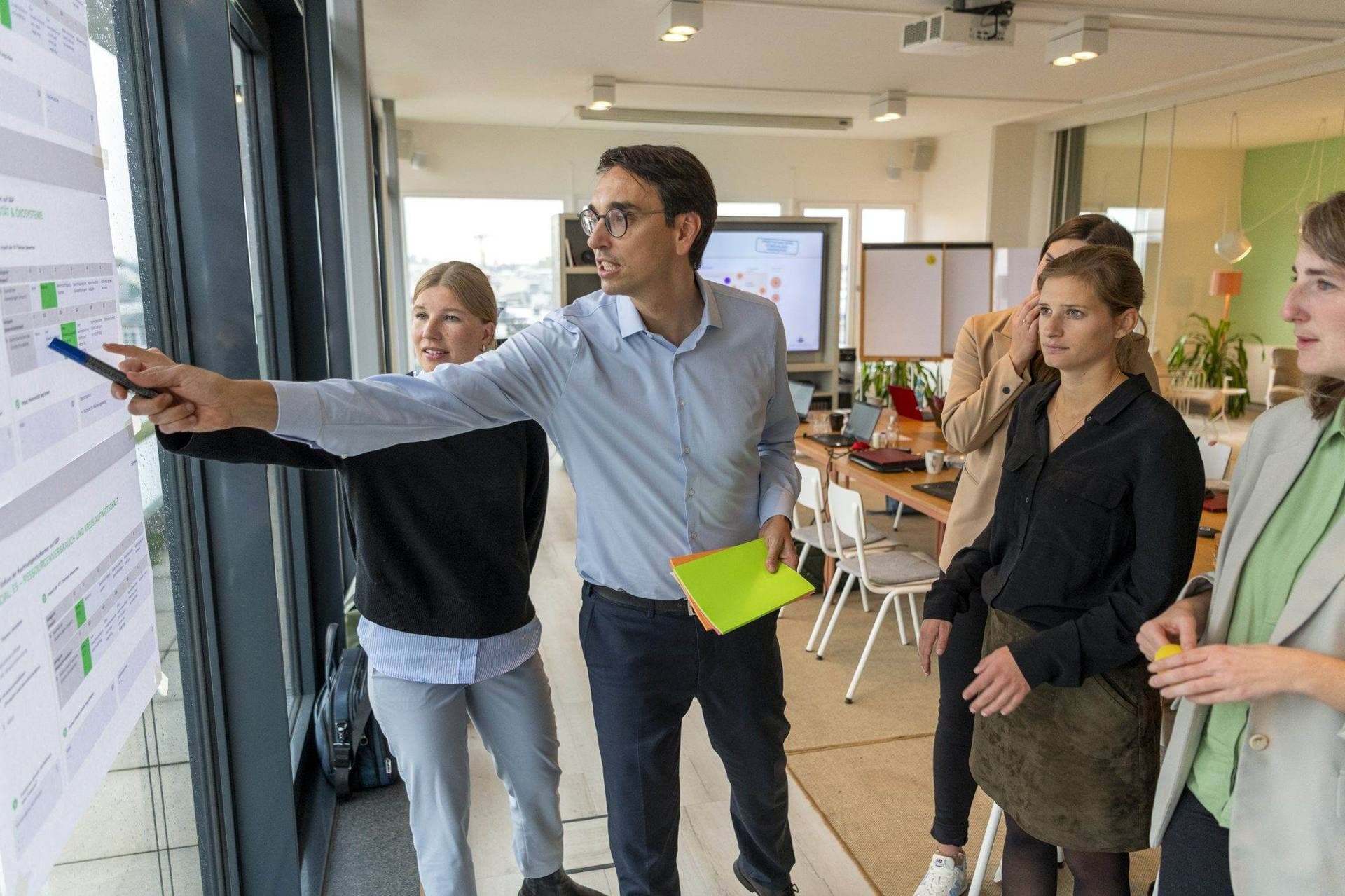
transformis consultant pointing at a wall while the team looks on

Case study

Logo DVV

From efficiency programme to forward-looking organisation

How a utility and infrastructure group tackled questions about its future across company boundaries.

  • Leadership, feedback and decision formats introduced at group and topic level.
  • The programme continued with digital participation formats during the pandemic.
  • Reviews documented in 2023 and a clearer division of roles between line management and corporate development.
Read case study

Prefer to talk directly?

What decision are you facing? Together, we clarify your situation, the people involved and the right next step.

Dr. Sina Haupt

Dr. Sina Haupt

Head of Leadership competence team | Senior Project Manager

Kira Rempel

Kira Rempel

Senior Consultant and Head of HR competence team

Your initial call

Let’s talk about your situation and what you want to develop in your organisation.

  • Your situation
  • What brings you to us
  • Possible next steps
Book an initial call