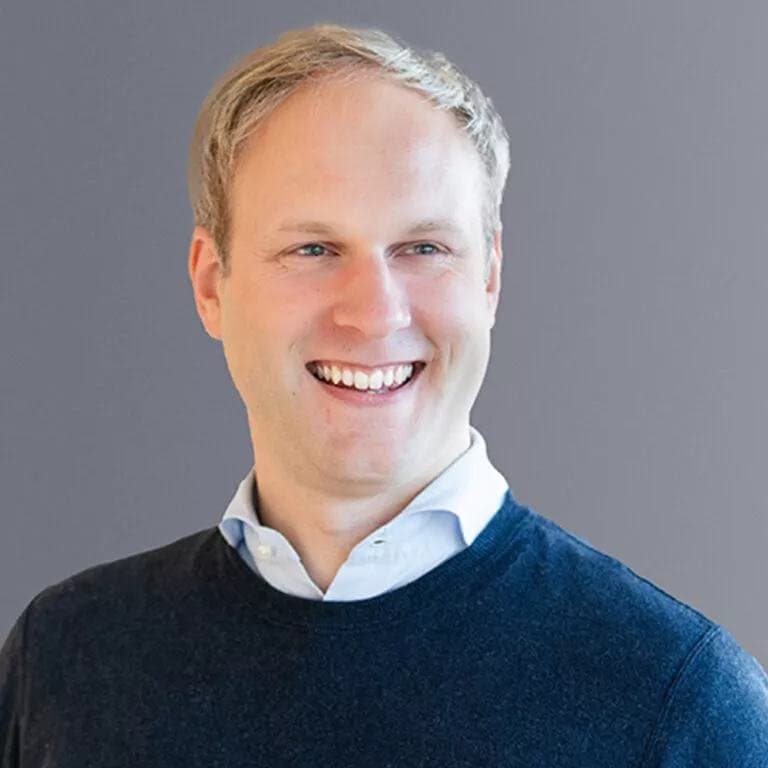
Brochure
The direct route to the future: Klartext.
For us, transformation is not an end in itself. It is the path to developing a lasting organisational capacity for renewal.
- Scope
- 48 pages
- Format
- Languages
- German, English
What you will learn in the brochure
- Why continuous strategic self-renewal is becoming a key core competence of future-viable companies
- How our integrated consulting model works
- What fundamentally distinguishes transformis® from conventional expert consulting
Capacity for renewal as an ongoing task
The brochure describes transformation as a way of developing a lasting capacity for strategic self-renewal. To this end, changes in markets, technologies and framework conditions are regularly observed and translated into decisions. The task extends beyond the completion of a single change project.
Recognising the right form of change
The model distinguishes crisis management and restructuring, ongoing optimisation, profound transformation and foresighted self-renewal. Some tasks are temporary, others permanent. The classification helps to clarify the assignment and the necessary depth of intervention: are existing processes being improved, or does the fundamental logic of work and decision-making in the organisation need to develop?
Connecting substantive issues, collaboration and timeline
The third mode of consulting incorporates the factual, social and time dimensions from the outset. In addition to the content solution, communication patterns, decision paths and how well the work connects with the leadership system are considered. A suitable intervention architecture links the steps. Experience from the process is regularly reflected on and incorporated into further work.
Considering eight fields of action together
Strategy, organisation, leadership, culture, talent, succession, artificial intelligence and organisational performance are linked to one another in the consulting model. A new strategy may, for example, require different roles and competencies; at the same time, the use of AI changes work processes and decisions. The specific assignment determines which of these connections need to be addressed.
- Strategy
- Organisation
- Leadership
- Culture
transformis®
Integrated consulting model
- People
- Succession
- AI and the world of work
- Optimisation
Leadership takes responsibility for the process
Top management is itself part of the change. It explains the need for action, provides orientation and involves the organisation in the relevant tasks. To this end, the brochure emphasises a comprehensible sequence of steps and continuous process reflection. The DVVision field report illustrates how a utility and infrastructure group worked on its foresighted development.

The scientific foundation: transformis® DNA
Types of change management and our consulting philosophy
The Klartext brochure summarises what the transformis® DNA sets out in detail. Here are the fundamentals: four types of change management, the third-order change process and the stance from which we consult.
Four types of change in organisations
Of these fundamentally possible change-altering interventions in the development of organisations, we focus below on the type of profound transformation.
1st order, permanent: ongoing evolutionary processes of change
temporarypermanent3rd order2nd order
Deep transformation
Foresighted self-renewal
Crisis management / restructuring
Continuous optimisation
Third-order change process
When is a profound transformation in a company’s development due? When the company has recognised that continuing on its previous path and holding on to its existing strategic direction, together with the associated structures and processes, will sooner or later lead it into an existential threat. Bringing about such a decision is a central task of the leadership system. These are transformation processes that intervene deeply in the historically grown identity and in the underlying structures and processes of the organisation. A profound restructuring of the existing organisational architecture and the associated leadership structure is due; this triggers great uncertainty in the organisation and brings with it an enormous potential for unrest that ties up attention for weeks and months in advance. In addition, these processes are under considerable time pressure, even though their successful implementation can take several months or even years. Their success depends on credibly communicating a correspondingly great, genuinely comprehensible, existence-threatening pressure that makes such transformations absolutely necessary and therefore explainable. Such restructuring processes need a carefully designed dramaturgy capable of transforming the organisation’s status quo into the respective target state within a reasonable period without reducing existing performance in the meantime (rebuilding while the engine is running). In addition to maintaining the performance of operations, this implies an enormous additional mobilisation of energy and provision of resources by the entire organisation. The goal of a profound transformation must be to deal in a targeted way with the organisation’s previous experience of handling such challenges and ultimately to evaluate this process in such a way that the organisation learns from it in a lasting way. This is a form of organisational change that inevitably puts the respective leadership system (functional/personal) itself under pressure to change. The necessary organisational change therefore requires a change in leadership. Change begins with the self-image of the decision-makers primarily responsible for the change. They must see themselves as a part of the change project that is critical to its success.
Requirements for management
With such far-reaching changes, a careful analysis of the experiences an organisation has had in the past with such “impositions” is required. As an essential prerequisite for success, accompanying reflection on the process must be ensured as an indispensable success criterion and steering element. In the initial situation, the need to be addressed must be communicated so comprehensibly that the organisation accepts it and is willing to go along. This involves overcoming the frequently observed “change fatigue” of organisations, because it is evidently becoming ever harder to convey the “sense of urgency” credibly (as it has often been misused in the past). A process architecture must be developed for the change initiative that is suited to the specific dramaturgy of such an initiative. Dramaturgy here means that the change initiative must be designed in a very specific sequence of steps according to its inner logic (this addresses the success-critical process dimension of such initiatives). These steps cannot be swapped or skipped at will. Each of these steps is characterised by very specific key decisions that need to be made, which require suitable forms of work. As a result, this means shifting expectations in the organisation from “certainty of results” to an orienting “certainty of process”.
Systemic organisation theory
All transformis® consulting services are based on the findings of systemic organisational theory.
According to this understanding, we do not primarily see the people in an organisation as the essential starting points for observation and intervention, but rather the organisation’s established frameworks for observation and evaluation and the characteristic communication routines with which information is generated and condensed into decisions.

Third mode
The third mode of consulting differs fundamentally from classic expert consulting. In addition to working on the content-related factual dimension, the social and time dimensions are also given equal consideration, synchronised and integrated in the architecture from the outset.
Sozialdimension Indirekte Weiterentwicklung der Kooperationsqualität und Entscheidungsfähigkeit des Teams bzw. des sonstigen Kommunikationsgeschehens in der Organisation.
Sachdimension Bearbeitung eines aufgabenbezogenen Problems der Organisation zur Sicherung bzw. Weiterentwicklung der organisationalen Leistungsfähigkeit.
Zeitdimension Beobachtung und Gestaltung der Unternehmensentwicklung im Zeitverlauf sowie Synchronisation unterschiedlicher Zeithorizonte in den verschiedenen Aufgabenfeldern. Vermeidung von Über- oder Untersteuerungstendenzen in der Organisation und Sicherstellung einer sorgfältigen Balance von Be- und Entschleunigung im Entscheidungsprozess
Unser Beratungsansatz
- Takes into account the high dynamics and self-referentiality of organisations
- Addresses the resistance that change meets
- Takes into account that actors in organisations do not only pursue organisational goals
Unsere Unabhängigkeit
- Ensures that we do not bring the blind spots of focused industry experts
- Makes it possible to bring in many perspectives and experience from other industries
- Creates new insights and makes it possible to develop previously unknown possibilities
Unsere Zusammenarbeit
- All working sessions are facilitated, all results documented in the consulting setting
- Every working session ends with minutes accepted by everyone present
- Every setting is reflected on, evaluated and feeds into the next preparation
Unsere Branchenunabhängigkeit sichert Unvoreingenommenheit und Offenheit. Wir wenden unsere branchenübergreifenden Erfahrungen auf Ihren spezifischen Kontext an und schaffen neue Lösungen, die aus der Branchenperspektive alleine so nicht entstehen.
When external consulting is necessary
Externe Beratung bietet einen klaren Mehrwert, wenn…
- blind spots need to be uncovered and irritating perspectives are needed, and when leadership itself needs to become the topic
- established patterns that are no longer helpful need to be identified and broken
- it is about highlighting a difference from the organisation’s internal routines
- complex change needs facilitating, structuring and stabilising
- specific methodological and systemic expertise is needed
- Prozessarchitekturen zu bauen
- internal routines and thought patterns are blocking further development
- neutrality and independence are required (especially when conflicts, competing goals or internal politics are blocking decisions)
- new forms of networking and logics of cooperation are needed
- consulting systems are established (structural coupling between organisation and consulting)
it is about holistic transformation and not just optimisation. “Real” transformation requires impetus, reflection and professional process management of all services, which can hardly be fully provided internally. In other words, whenever the performance of the overall system has to be raised to a completely new level
What external consulting can achieve that is difficult to do internally:
Blinde Flecken sichtbar herausarbeiten
- Organisations do not see what they do not see
- External consultants irritate routines, thought patterns and assumptions, thereby opening up new perspectives
- Neutrality / all-partiality and “unsparing candour” on sensitive issues
- External consultants are not part of internal politics
- They can voice uncomfortable truths, facilitate conflicts and resolve decision-making blockages
- Methodological expertise that is not available internally
Systemic models, process architectures, meta-communication, structured conflict facilitation – all of this requires expertise that is rarely available internally at this depth
- Professional process management beyond day-to-day business
- Internal staff are often caught up in operational pressure
- External consultants create focus, structure and consistency and stabilise change over time
- Enabling new forms of cooperation
External consultants can establish new networks, roles and decision paths across departments because they are not trapped in established patterns of cooperation
Enabling meta-reflection
- External consultants design reflection processes so that the organisation itself arrives at new insights
Independent, cross-disciplinary and cross-sector
Our consulting concept thus takes into account the high dynamics and existing self-referentiality of organisations, the associated resistance to change, and the naturalness of the fact that actors in organisations do not only pursue organisational goals, but bring a high degree of self-promotion and influence into a process in order to achieve personal goals
We do not bring the blind spots of the relevant industry experts and of the company’s internal habits of seeing; instead, we use diverse perspectives and also bring experience from other industries into the discussion in order to develop new insights and previously unrecognised possibilities for the organisation
Industry-specific specialist consultants, on the other hand, will give all companies in an industry the same or similar recommendations with regard to market assessment, competitive situation and trends, and therefore also the same recommendations for action; otherwise they would not live up to their claim to objectivity in their analyses and recommendations. As a result, this tends to intensify competition rather than create attractive new market opportunities
All working sessions are facilitated, and all results are shared within the consulting setting and documented online. This means that every working session ends with minutes accepted by everyone present. Afterwards, transformis® reflects on and evaluates each setting internally. The insights then feed into the preparation of the next setting
Consulting philosophy and practice
Prefer to talk directly?
Would you like to apply the content to your company? Let’s talk about it.
Your initial call
Let’s talk about your situation and what you want to develop in your organisation.
- Your situation
- What brings you to us
- Possible next steps