
Fundamentals
What is organisational transformation?
Transformation as organisational development: how strategic self-renewal connects with structures, culture and leadership.
Read moreStrategic planning under uncertainty: how leadership teams stay able to decide with a vision of the future, a strategy team and a regular strategy review.
Setting future direction under uncertainty requires leaders to make far-reaching decisions even though the future is uncertain and the environment cannot be fully understood. Anyone who does not tackle this task deliberately simply carries the success patterns of the past into tomorrow. This article shows which basic assumptions decision-makers can rely on, what a vision of the future achieves, and how a strategy team, the strategy wheel and the strategy review turn shaping the future into a shared leadership task.
The everyday life of many managers is dominated by operational tasks. There is often a lack of time, freedom and energy for questions that reach beyond the day. Yet it is precisely these questions that are part of management's task. Shaping the future means bringing about far-reaching and quite risky decisions under considerable uncertainty and justifying them rationally, knowing full well that things may turn out differently. This creation of certainty in the knowledge of unavoidable uncertainty is the core of leadership.
Without deliberately shaping the future, a company tends to steer into the future by looking in the rear-view mirror. The greater the success of the past, the harder it is to overcome its “immunising power”. The focus is therefore on the capacity for strategic change: observing the relevant environment, reviewing existing assumptions and readjusting the strategic reference points so that the company stays on course when unforeseen developments fundamentally change the framework conditions.
Alongside the operational challenges of day-to-day business, issues from the social, societal, economic and environmental dimensions are gaining importance, challenging and changing business models. These include climate change and sustainability, demographic change and the shortage of skilled workers, new worlds of work, geopolitical shifts, disrupted supply chains, cost risks and regulation.
The multi-level perspective according to Geels and Schot arranges such developments on three levels. Overarching dynamics put pressure on the existing socio-economic, political and technical structures, that is, the fabric of markets, industry, science, politics, technology and culture. In niches, small innovative networks of various actors support innovations on the basis of shared expectations. When a window of opportunity opens, a new configuration prevails and leads to adjustments in the established fabric.
Companies are living social systems. They can neither be calculated through linear cause-and-effect relationships nor trivially steered from outside or by a single manager. According to Niklas Luhmann, social systems consist of communication. The basic element of the company is the decision, which for a moment turns uncertainty into certainty and makes subsequent decisions possible.
Because its environments are more complex than the organisation itself, it has to select what it treats as relevant. No system would be able to act if it had to react to every environmental event. Environmental events initially act as noise that can irritate, but need not. What is taken up is what connects to internal structures and routines.
This operational closure provides the stability for efficient performance. At the same time it carries the risk of becoming blind to the demands of the environment. This explains a corporate crisis: demands from relevant environments have found no resonance over a long period.
Every company that holds its own in the market over a long period has a strategy and its own method of answering questions about the future. Wimmer and Nagel distinguish four variants, depending on whether strategy formation happens implicitly or explicitly and whether it takes place outside the organisation as a given or within the management processes.
With intuitive decisions, the top of the company sets the course based on entrepreneurial instinct, often in pioneer and family businesses. The leadership resources of middle management remain unused, and succession can become an existential question. Evolutionary strategies emerge more or less by chance in the free play of forces and are often interpreted after the fact as intended. Expert-oriented strategy development explicitly delegates the work to external consultants and relies on rational analysis. The fourth form, strategy development as a joint leadership achievement, uses and combines the other three.

According to Wimmer and Nagel, the expert-oriented form rests on three problematic basic assumptions. Plannability means that the knowledge needed for strategic decisions can be fully mobilised if the right approach is taken. Calculability assumes that the market and competition follow recognisable laws from which reliable success strategies can be derived. Trivialisation treats the organisation as a mere instrument for implementing given goals.
The weak point shows in implementation. First comes thinking, then implementation, often by different groups of people. Many strategies remain ineffective even though their content is usable, because they do not connect with the organisation. The old assumptions are replaced by three new ones: the environment of companies cannot be fully understood. The future is and remains uncertain. As a complex social fabric, the company is not a trivial machine.
Uncertainty is often lamented. In fact, it is the basic precondition of entrepreneurial action. If all competitors knew for certain how markets, social needs and customer behaviour would develop, there would no longer be any lead to gain. Success comes to those who discover needs and problems for which there are no good solutions yet and find smart answers to them.
This means the paradigm “Structure follows strategy”, which sought to adapt companies as well as possible to given environmental conditions, loses its validity. Expert analyses suggest similar views to the companies in an industry, which intensifies competition and creates no differentiation. In the new understanding, it is about uniqueness in relevant performance dimensions and about actively helping to shape one's own market. Strategy development is a circular process of loose couplings: environment and strategy influence each other, as do strategy and organisation.
Strategy is an essential dimension of leadership. It addresses the difference between present and future and gives the company a perspective for the future. In terms of content, it describes the positioning in the market: in which markets the company operates, which target customer segments it concentrates on, what benefit it offers and how this sets it apart from the competition. Strategy work is a regular process of reflection and decision-making in the management system with the participation of key players, not an elaborate special process for a particular occasion.
Left to themselves, organisations deal with the problems of the past. A picture of the future opens up the difference from the present and provides identity and orientation. It must be understood by employees and covers the future business identity, the strategic positioning, the associated growth and profitability targets and the key metrics of strategic management. Since the future cannot be calculated, the work is done on the basis of assumptions.
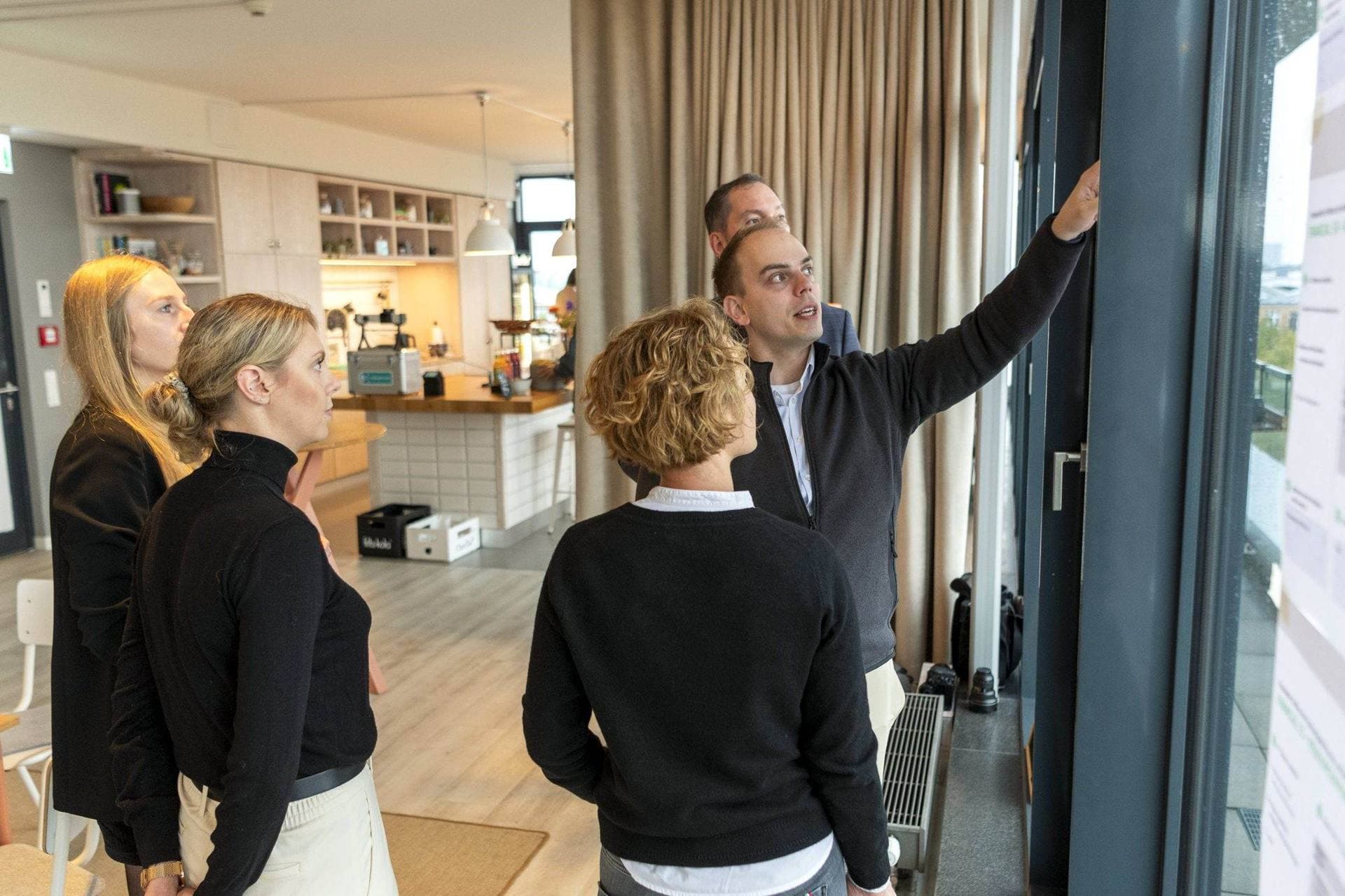
The knowledge needed to shape the future exists within the organisation. To mobilise this system intelligence, a strategy team is formed. The management team responsible for decisions is indispensable to it. It is joined by key players from other areas of responsibility, including important holders of know-how, people with formal or informal power and up-and-coming managers. Different viewpoints reduce the blind spot. The participants later carry the consequences into their areas of responsibility. To keep the process manageable, the team should comprise no more than twelve people.
The strategy wheel describes the ideal sequence. First, framework conditions are described and assumptions about future developments are made explicit and shared within the team. This is followed by the core capabilities, the strategic challenges and the development and evaluation of options according to profitability, feasibility, prospects of success and risks.
The picture of the future emerges from this. Goals, measures, a strategy map with a system of key figures, organisational restructuring and implementation follow. Depending on the starting situation, for example identity-seeking and resource-oriented or market-driven, different steps come to the fore.
Strategic commitments provide focus and keep the organisation able to act. At the same time, they must remain open to revision. In the regular strategy review, the strategy team examines whether the assumptions still hold, which commitments it deliberately holds on to despite signs of a need for change, and which it must change to secure business success. The effect of strategic initiatives and the routines of strategy work itself are also examined. Those who communicate the probability of error of a decision from the outset make later correction easier.
The benefit of the review also lies in the leadership group itself. Current trends and market developments are assessed together, and the assumptions are shared within management. This creates commitment and accountability among the decision-makers, an essential precondition for effective implementation. In this understanding, strategy development is a capability of the organisation that is developed deliberately, and a lever for its ability to learn. In the medium term, the organisation should go through such processes on its own.
Consulting in the third mode addresses the social and time dimensions on an equal footing with the factual dimension. It does not bring a ready-made positioning with it. Its main task is to deliberately irritate established patterns of observation and explanation, to design the architecture of the workshops and to document results clearly so that assumptions remain traceable later. In dynamic markets, competitive advantage is founded on the organisation's long-term capacity to respond.
Leadership makes far-reaching decisions on the basis of assumptions, even though the future remains uncertain. What matters is reviewing these assumptions regularly and readjusting the reference points.
It assumes predictability, calculability and an organisation that functions like an instrument. Many such strategies fail in implementation because they do not connect with the organisation.
The future business identity, the positioning in markets and target customer segments, the offering, growth and profitability goals, and the key indicators for strategic steering.
It puts the existing strategy to the test in the light of developments in the environment. The strategy team clarifies what it deliberately holds on to and what it needs to change.
Fundamentals
Transformation as organisational development: how strategic self-renewal connects with structures, culture and leadership.
Read more
Fachartikel
Organisational resilience meaning: how companies pick up signals of change, deal with shifting conditions and actively shape their own development over time.
Read more
Fachartikel
Leadership as an organisational function: how roles, expertise and the six tasks of the leadership wheel turn uncertainty into shared decisions.
Read more