
Orientation
Strategy process: how it works, step by step
From the starting situation through future options to implementation: the steps and decisions of a strategy process and how they fit together in practice.
Read moreStrategic self-renewal, long-term competitiveness and business models.

Which assumptions about customers, value creation and competition still hold – and which do you need to test?
Where are customer needs or competitive conditions already changing noticeably?
Which strengths of your company remain relevant under these conditions?
Which decisions are due, even though the future is still uncertain?
Start by checking which assumptions about the market, customers and competitors still hold. The strategy check gives you a basis for deciding what to continue and what to realign.
Customer segmentation matches different customer needs with a suitable value proposition. It helps you review your business model and positioning from the customer’s point of view.
Strategy implementation translates direction into shared goals, decisions and ways of working. Forward-looking monitoring then asks whether the chosen steps are having the intended effect.
Orientation
From the starting situation through future options to implementation: the steps and decisions of a strategy process and how they fit together in practice.
Read more
Orientation
Uncertainty, customer feedback and clear decision frameworks: criteria for choosing agile ways of working that suit the task and your organisation.
Read more
Orientation
Expert consulting, process consulting and the third mode compared: what each form delivers, where its limits lie and when it is the right fit for you.
Read moreFundamentals
Transformation as organisational development: how strategic self-renewal connects with structures, culture and leadership.
Read more
Fundamentals
The third mode explained: how the factual, social and time dimensions of a transformation architecture fit together, and why they are planned jointly.
Read moreFundamentals
Ambidexterity meaning and practice: how leaders combine exploitation and exploration to run the core business and develop new business at the same time.
Read more
Fundamentals
Variation, selection and restabilisation: how an organisation keeps working on its future development through strategic self-renewal alongside daily business.
Read moreFundamentals
The four types of change: crisis management, continuous optimisation, profound transformation and foresighted self-renewal, and what each demands of management.
Read more
Article
Organisational resilience meaning: how companies pick up signals of change, deal with shifting conditions and actively shape their own development over time.
Read more
Article
Needs-based customer segmentation: how to distinguish customer groups by what they expect from you, and which business decisions follow from the segments.
Read more
Article
How customer expectations, your own capabilities and positioning come together in a robust value proposition that your organisation can actually deliver.
Read more
Article
A strategy map connects finance, customers, processes, and learning and growth in one shared picture of strategy, linking objectives with their prerequisites.
Read more
Article
Strategic management means telling apart action status, goal achievement and leading indicators of impact. How to judge whether your strategy really works.
Read more
Article
Low cost, product performance, total cost or individual solutions: how to tell strategic options apart and understand their organisational consequences.
Read more
Article
Purpose, Planet, People and Profit as strategic perspectives, connected with stakeholders, processes and capabilities in one sustainability strategy.
Read more
Article
Cultural due diligence assesses cultural fit before an M&A deal: definition, what to look at, process, duration and how to handle cultural conflicts.
Read moreArticle
The M&A process in six steps: from strategy development through due diligence and closing to post-merger integration, with timeframes for each phase.
Read more
Article
PESTEL analysis captures external factors systematically and shows what they mean for your HR strategy, your HR processes and your priority areas for action.
Read moreArticle
Consulting for companies with business in China: cross-cultural collaboration, an office in Shanghai, and recruiting and developing talent locally.
Read moreArticle
CO₂-neutral, greenhouse gas neutral, climate neutral, net zero: what the terms mean and which requirements they create for companies in practice.
Read moreArticle
The Corporate Sustainability Reporting Directive (CSRD) governs sustainability reporting in the EU: its aim, the ESRS, related rules and opportunities.
Read moreArticle
Scope 3 emissions arise along the value chain: the GHG Protocol's Scope 3 Standard, its 15 categories and their minimum boundaries explained.
Read moreArticle
A GHG inventory records a company's direct and indirect greenhouse gas emissions: scopes, standards and the steps to follow under the GHG Protocol.
Read moreArticle
A CSRD materiality assessment applies the principle of double materiality to determine, in four steps, which topics a company must report on.
Read more
Article
Business practices in China: how institutions, relationship networks and culture interact, and the principles on which a coherent China strategy is built.
Read more
Article
Innovation capability depends on structure and culture: exploration and exploitation, five success factors and the path from idea to scaling the business.
Read more
Article
Why customer satisfaction says little about loyalty, how the threshold value serves as a better yardstick and how transformis approaches the analysis.
Read more
Article
How non-profit organisations can use the Delta Model by Arnoldo Hax to segment their stakeholders, create value for them and achieve a system lock-in.
Read more
Article
Operational excellence after Treacy and Wiersema: best total cost for the customer, how it differs from cost leadership, and what it means for the organisation.
Read more
Article
Outside-in analysis feeds the views of customers and the market into strategy work and reveals what an organisation tends to overlook on its own.
Read moreArticle
How mid-sized chemical companies can balance cost discipline with investment: the causes of the crisis, dual transformation and re-dimensioning.
Read more
Article
A strategy review tests your market positioning and how far the strategy has really been implemented: six areas to clarify, fourteen key questions, six steps.
Read more
Article
The Zukunfts-Forum is a compact strategy format that helps leadership teams secure or realign their core business: process, results and success factors.
Read more
Article
Strategic planning under uncertainty: how leadership teams stay able to decide with a vision of the future, a strategy team and a regular strategy review.
Read more
Article
Marcus Wittig, Chairman of the DVV management board, on why DVVision was launched, how it has progressed, its results and what it means for customers.
Read moreArticle
Robert A. Sedlák, CEO of transformis, on DVVision as third-order change, what it takes to succeed, and the role played by joint consulting systems.
Read moreMarkets, customer expectations and your own capabilities are the starting point. We work with you on positioning, customer segmentation and your value proposition.
A positioning names the target customers, the specific benefit for them and what the company needs to deliver it. Customer segmentation first examines differing expectations. Strategic options are then weighed against the company’s own capabilities and their consequences for processes, skills and decisions. Market positioning is therefore part of strategy work, not just a slogan.
A strategy needs to connect with decisions and implementation. That is why strategy review, strategy implementation and impact monitoring are part of our services.
Strategy work starts with the current situation and combines the internal view with observations of customers, markets and competitors. Core competencies and strategic options are identified and assessed. The chosen positioning gives rise to objectives and initiatives. A Strategy Map can show how they connect. Regular reviews test assumptions against experience from implementation.
Strategy development is an essential leadership task that cannot be delegated, addressing the difference between present and future. In doing so, we turn away from plan-determined corporate management and understand strategy development as an essential, hypothesis-based leadership process. Strategy work comprises a regular process of reflection and decision-making for shaping the future and coping with uncertainty. The aim of strategy development is to reveal a difference between present and future and to design an attractive vision of the future that provides clear orientation for concrete implementation.
An organisation needs a meaningful vision of the future that encompasses its future business identity and future strategic positioning. It answers in which markets the organisation will operate in future, which target customer segments it will focus on and how offerings will be designed, as well as which business models or which entrepreneurial identity result from this for the company.
We put the customer at the centre and move away from a product- and competition-oriented perspective on strategy development. The focus is on serving and working with customers strategically, with a clear understanding of the threshold benefits (the minimum expectations of a customer segment) and the differentiation potential of different customer groups, which enables customer management to be individualised in as standardised a way as possible.
Strategy development is not a special process whose results soon lose their validity. Rather, it is an integral part of leadership with the aim of keeping decisions about identity open to review and correction in the face of changing environmental conditions. Companies are therefore called upon to make forward-looking assumptions jointly and to actively shape their future. Given the enormous volatility of companies' relevant environments today, this has become a capability that can hardly be overestimated.
Our basic hypothesis: in their management practice, organisations tend primarily to look to the past. Left to themselves, in their day-to-day operational problem-solving they mainly attend to the problems that currently prevail. If this coping pattern is to be interrupted, the organisation's leadership must be fundamentally oriented towards the challenges of the future. The future, however, is and remains uncertain and must be shaped deliberately by the organisation itself (the future cannot be calculated). The “immunising power” of past successes must be overcome; the fundamental uncertainty that comes with shaping the future is not seen as a problem, but as the source of all entrepreneurial activity. The aim of strategy development is to make the company leadable from its desirable future.
This understanding of strategy development requires abandoning the assumption that strategy can calculate the future and provide reliable certainty.
Orienting exclusively towards competitors and benchmarks (e.g. through advice from expert consultancies) prevents differentiation and means that companies do not stand out from their competitors (never better than the comparison at best).
Critical to the success of strategy development is careful consideration of the uniqueness of one's own organisation (the organisation's core competencies, the explicit and implicit expert knowledge within the organisation, …). For this in particular, using the system intelligence throughout the organisation is extremely helpful. This targeted use also leads to broad commitment to the results of strategy development throughout the company.
Successful strategy development leads to a coherent interlocking of the basic assumptions, that is, the essential assumptions about the relevant environments, with the strategic positioning derived from them and with an organisational design of the company suited to it. This interlocking ensures a consistent outside-in logic in shaping the organisation's internal conditions, in order to develop them further and secure them for the company's future ability to respond. In everyday work, this coherence ensures that the strategic direction is effectively integrated into operations:
The focus is on the company's strategic capacity for change, i.e. observing its relevant environment, reviewing existing assumptions and readjusting its strategic reference points, so that a company stays on course even when unforeseen developments have fundamentally changed the framework conditions (ability to respond to surprising disruptive change).
The challenge for the organisation is to question its established patterns of observation and explanation (above all regarding developments in its environment), to deliberately irritate the organisation again and again, and to change in a targeted way how it observes, produces information and knowledge and makes decisions. If this does not succeed, there is a danger that the players simply keep playing the “old tune”, confirm one another in their views and explanatory patterns, and that these become further entrenched.
At its core, it is about overcoming the “immunising power” of past successes, not resting on previous successful projects and, against this background, not playing down disturbing external developments within the company and normalising the resulting consequences in a way that reassures everyone.
The aim must be to develop a jointly supported target state / vision of the future that can be understood, shared and implemented in the organisation sustainably and consistently. There is no point in developing a strategy that gets shelved; only an effectively implemented strategy is a good strategy.
transformis Consulting SE positions itself as a consultancy for transformation in strategic contexts. In this role, transformis® does not act exclusively as a purely systemic process consultancy, but offers sophisticated business know-how in order to integrate it effectively into the strategy-finding process together with the proven methods and tools of classic strategy consultancies.
In doing so, transformis® breaks away from traditional, problematic assumptions about the plannability, calculability and trivialisation of the future. These basic assumptions suggest a false sense of security and miss the fundamental problem of dealing with the future and the unavoidable uncertainty associated with it.
An essential basis is jointly formed hypotheses and assumptions about the effects of current developments in the environments relevant to the company. These hypotheses must not be understood as fact, but must be regularly reviewed and adjusted. Strategy development requires considering which commitments are deliberately retained and which are to be changed in order to secure long-term competitiveness. The strategic direction taken is regularly put to the test against the background of changed framework conditions and adjusted if necessary.
Our approach is based on combining the expert know-how of the key players in the client's own organisation, a systemic view of organisational and strategy development, and the use of concepts and methods from classic expert consulting.
We professionally support and advise companies on the tasks that arise in strategy development – we supply the organisation with relevant external signals and, together, integrate the results into an individual positioning for our clients that is unique in the market. By way of example, this means using: market and competition analysis; trend and environmental analysis; customer analysis and segmentation; core competence analysis; core strategic topics; deriving strategic options; identity development, developing a strategy map including a master plan; designing customer-segment-specific value propositions.
By combining the strategic perspectives on finances, markets and customers, internal processes and organisational enablers (people, organisational design, culture, systems) into plausible chains of effect, viability is consistently secured and effective implementation of the strategy is considered and enabled from the outset (combining thinking and acting).
Expertise in strategy development combined with a systemic view of organisational and strategy development, so that the process fits your organisation precisely.
Development and implementation are considered together from the outset (finances, customers and markets, internal processes, organisational enablers), ensuring that no plans are developed only to be shelved, but that implementation and effectiveness are secured from day 1.
Jointly designing and implementing a strategy development / strategy review process that fits the specific environments and framework conditions optimally, so that acceptance, decision-making capability and speed of implementation increase significantly.
A comprehensive and strongly integrative understanding of strategy ensures that all relevant aspects feed precisely into the process and that the right information (figures, data, facts) and signals are taken into account and processed at the right time, so that strategic decisions are made faster and with higher quality.
Using system intelligence, i.e. the knowledge available in one's own organisation, network and wider ecosystem, and connecting with the many different perspectives to ensure viability throughout the entire strategy development process (enabling valid strategic options).
Supplying the organisation with relevant external (new) signals and introducing necessary irritations in order to overcome entrenched patterns and open the organisation up to “the new” (variation).
Stakeholder management, involving relevant key players, building commitment and creating the necessary decision-making capability (joint selection of the options developed). The power to implement increases, conflicts are reduced and strategic measures gain momentum.
Making core strategic topics, questions and decisions tangible and communicable, so that commitment and a willingness to act become possible across all levels (this secures re-stabilisation of the change that has been initiated).
Support and advice throughout the entire implementation as well – no one is left alone until the desired effects have been achieved and permanently embedded (re-stabilisation).
Ensuring a suitable working architecture that can mobilise the necessary know-how for the individual steps of the process. This includes implementing and setting up a consistently stable strategy team in which top management and important key players from the company are connected. In addition, other know-how holders in the company are involved in a targeted way in individual phases of the process (creating a well-thought-out participation architecture for the overall process).
Benefits at a glance:The benefit of this practice area is not limited to developing a viable strategy. It also lies in the organisation's ability to continuously review its strategic assumptions, recognise changing environmental conditions early on and develop its strategic direction further with foresight. In this way, continuous strategic self-renewal becomes a lasting organisational competence and the basis for long-term competitiveness.
transformis® leaves a purely product- and competition-based view behind and follows a highly individual and integrative end-to-end strategy development with the aim of customer retention and development.
Extensive international experience from a large number of strategy processes involving relevant key players, resulting in viable and unique positionings – never an off-the-shelf concept.
No industry blindness and no pure benchmark orientation – individuality based on your own strengths and competencies → guaranteed unique strategic positioning (a unique market position instead of me-too).
An overarching entrepreneurial view, from financial goals and effects on markets and customers through to the necessary changes in internal processes, structures, systems or personnel and cultural aspects.
Parallel strengthening of the capacity for self-renewal and lasting enablement of the organisation, so that it can create impact within the new strategic framework conditions and realise the planned effects.
A clear, scientifically grounded approach and methodology.
Process support in development and implementation in the third mode of consulting, i.e. simultaneously taking into account the content level, the social level and the process level.
We ensure that transformation contributes to the overarching corporate goals and an attractive future and does not take place as an end in itself.
These services address different tasks. The specific situation determines which of them belong together.
Strategy check: test your strategic assumptions and prepare concrete decisions on markets, customers and competition before a full strategy process.
Needs-based customer segmentation: distinguish customers by what they expect, then derive value propositions and clear priorities for portfolio and sales.
Business model development: find new ways to create value from customer benefit and your own capabilities, and assess each option before choosing a direction.
Strategy implementation: turn strategic decisions into initiatives, clear responsibilities and reliable collaboration, so strategy changes how you work.
Strategic self-renewal: build the ability to pick up on change early, assess it strategically and embed what matters firmly in your organisation.
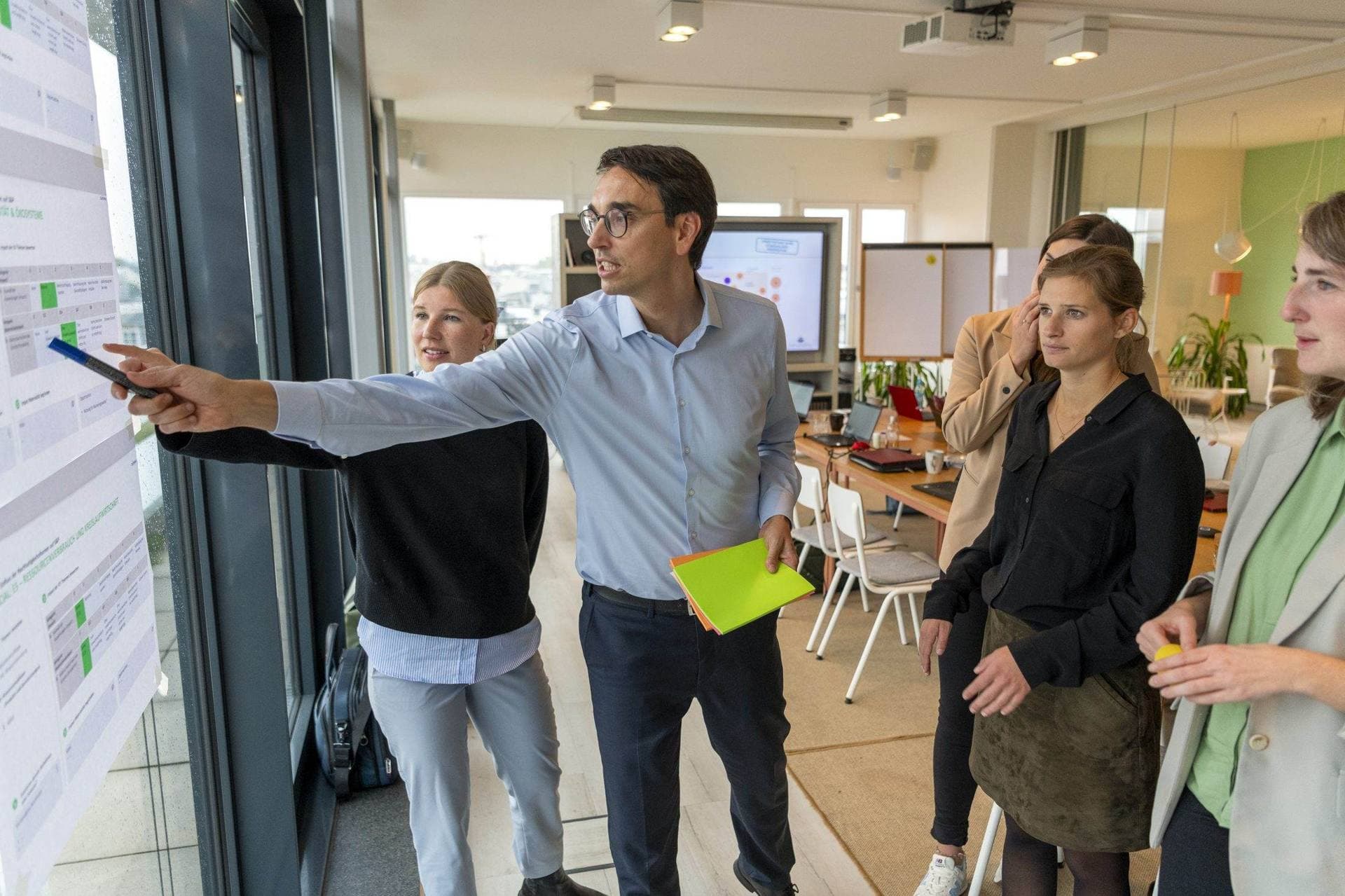
Case study
How a utility and infrastructure group tackled questions about its future across company boundaries.
Background information
16 pages · 2018 · readable online
Read onlineSpecialist article
22 pages · 2020 · readable onlineMarkus Peterhänsel
Read onlineBackground information
10 pages · 2020 · readable online
Read onlineBackground information
16 pages · 2019 · readable online
Read onlineThese articles come from our previous website. Each shows its original publication date.
What question is your company facing? Let’s talk about your brief and sensible next steps.
30 minutes, free of charge, by phone or video. Choose your time directly in the calendar.

Director | Chief Operating Officer (COO) | Head of corporate strategy competence team
Let’s talk about your situation and what you want to develop in your organisation.