
Fundamentals
What is organisational transformation?
Transformation as organisational development: how strategic self-renewal connects with structures, culture and leadership.
Read moreStrategic management means telling apart action status, goal achievement and leading indicators of impact. How to judge whether your strategy really works.

A project can hit all its deadlines and still contribute little to strategic development. To judge impact, you need to look not only at implementation status but also at the assumptions behind the actions.
Strategy work takes effort. Setting the course, drawing up action plans and implementing them across the board ties up a great deal of attention. In the process, it is easy to lose sight of how to recognise whether the strategy is actually taking hold.
Some companies are then faced with a puzzle: despite intensive and costly strategy development, success is not noticeable, and the cause is difficult to pin down. Forward-looking effectiveness monitoring starts at this point. It builds on the action plan and is intended to show early on whether the measures initiated are suitable for achieving the strategic goals.
It shows whether agreed activities have been carried out and milestones reached. This information is necessary for operational steering. But on its own it does not answer whether the intended change is coming about.
Target key figures describe the level of goal achievement. Their development can depend on several influences. A good result therefore does not automatically confirm every measure. A poor result does not yet explain its cause.
Monitoring measures checks milestones and budgets. It focuses on doing things right, and less on doing the right things. Monitoring strategic goals compares what has been achieved at the end of the planning period. It rewards or sanctions and plans corrections for the next period. Behind this is the assumption that implemented measures will achieve the goals. Cause and effect remain open. Steering looks in the rear-view mirror.
The leadership team agrees which early changes are expected and what would speak against the assumed impact. Observations are evaluated together. It is also determined when a topic must be decided again.
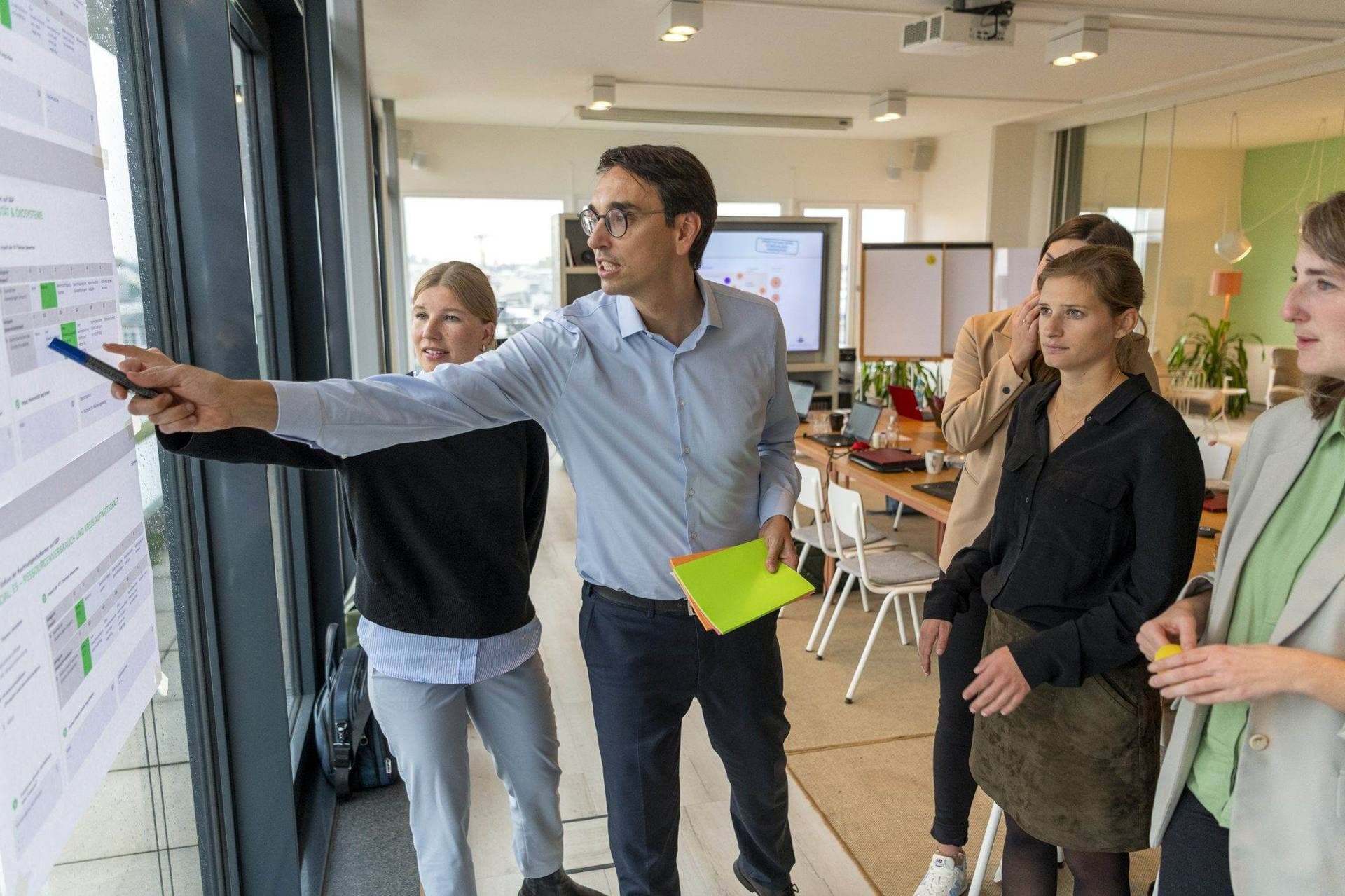
The set-up is divided into two phases of four steps each. The first phase clarifies exactly what is to be observed. Goals and measures are brought together in a strategy map, checked for plausibility and completeness and described in terms of their cause-and-effect relationships. The result is the jointly supported top goals of the customer and financial perspectives.
The second phase clarifies how observation and evaluation are carried out. It begins with an introduction to second-order observation, i.e. looking at one's own frame of observation and evaluation instead of only through it. The team then develops forward-looking observation points and the associated evaluation points. Finally, the results are summarised in a compact monitoring and the routines in which it is discussed are agreed.
What are we actually observing? Which assumption does this support or call into question? What alternative explanation is possible? What decision follows from this? Such questions link information with responsible readjustment.
The method explicitly asks at which developments a measure should be questioned, changed or ended. Observation points describe how a development can be recognised. Evaluation points determine when it requires a decision. Both are agreed with those responsible. This creates a shared framework for dealing with uncomfortable observations in good time as well.
The operator of an industrial site defined three top goals each for four strategic initiatives: customer management, site settlement management, efficiency and site. For customer management, one goal was to increase the loyalty of focus customers. In the short term and internally, it was observed whether the threshold benefit for each customer segment was being met in all business areas. In the medium term and externally, indices for customer satisfaction and customer loyalty counted. In the long term, the type, number and scope of strategic projects with customers were tracked.
Separately, implementation monitoring ran with measures, time horizon and degree of completion. Reasons for escalation included, for example, if there were no strategic projects with focus customers, if their expansion investments went to other sites or if the indices for focus customers did not rise. A plan could also be an early indicator: a project pipeline without sufficiently promising initiatives.
If certain observation and evaluation points have led to success in the past, this confirms their continued use. Organisations also tend to reinterpret the unexpected as the expected. This creates blind spots in the frame of observation. Whether something is considered good or less good depends more on the evaluation criteria than on the facts. Monitoring therefore includes a regular review of the observation and evaluation points themselves.
A project can be completed on time without the strategic goal being achieved. Effectiveness monitoring keeps these levels apart. Activities describe what was done. Result values show an observed state. Assumptions about impact explain why a measure is supposed to have contributed to it. A monitoring system therefore agrees before implementation which changes are expected and which data can make them recognisable.
Leadership and departments look at the key figures together with customer feedback and experience from the work. Deviations are explained first, before further measures are decided. This can also reveal that the original assumption about the market or the organisation was wrong. A dashboard is useful for this if it prepares the discussion, but it does not make the decision itself.
No. Activity, observed result and strategic impact must be distinguished.
Before implementation, related to goals and verifiable assumptions.
It raises a question about causes, not an automatic measure.
It prepares the joint assessment; the decision remains with those responsible.
Fundamentals
Transformation as organisational development: how strategic self-renewal connects with structures, culture and leadership.
Read more
Fachartikel
Organisational resilience meaning: how companies pick up signals of change, deal with shifting conditions and actively shape their own development over time.
Read more
Fachartikel
Waiting times, duplicated work and coordination effort tie up time and resources. How to use them as starting points for developing your organisation.
Read more