
Orientation
Coaching or organisational development: which fits?
Coaching or organisational development? How to tell individual development issues from recurring organisational patterns and choose the right support.
Read moreLeadership systems, responsibility and effective collaboration in the leadership team.
How must leaders work together so that important decisions about the future are prepared, made and implemented?
Which decisions stall or keep coming back?
Are responsibility, mandate and involvement clear enough?
Which issues need the leadership team to work together?
Coaching helps with personal questions about your role. If several managers struggle with the same contradictory demands, the organisation belongs in the brief too.
A new leadership role comes with expectations, relationships and decisions. Shaping the transition deliberately helps you understand the starting point and put your first steps in context.
Roles, committees and decision routines determine how leadership works together. Work on the leadership system links these conditions to the responsibility of the people involved.
Orientation
Coaching or organisational development? How to tell individual development issues from recurring organisational patterns and choose the right support.
Read more
Orientation
Your first 100 days as a new leader: how to consciously clarify your mandate, expectations and working relationships when leadership changes hands.
Read more
Fundamentals
Ambidexterity meaning and practice: how leaders combine exploitation and exploration to run the core business and develop new business at the same time.
Read more
Fundamentals
How internal facilitation can support groups as they work through problems and decisions, and how it helps build in-house capability to support change.
Read moreArticle
Leadership as an organisational function: how roles, expertise and the six tasks of the leadership wheel turn uncertainty into shared decisions.
Read more
Article
Succession in a family business touches family, ownership and management at once. How to look at all three together and plan the transition with foresight.
Read more
Article
Potential vs performance: why strong performance today does not fully explain suitability for a future role, and what talent management must distinguish.
Read more
Article
How information, participation and follow-up decisions shape leadership work, and what a decision-making culture needs so that decisions are implemented.
Read more
Article
How leaders organise orientation, participation and feedback during change, and why it matters to separate what has been decided from what is still open.
Read more
Article
Work 4.0 and New Work at a glance: how they differ, what defines the modern world of work and what it demands of leadership and of the organisation.
Read moreArticle
How companies align their lived understanding of leadership with strategy and organisation, and so strengthen both their culture and their performance.
Read more
Article
Systemic team coaching creates the conditions for high-performance teams: goals, perspectives, process and approaches for better team dynamics.
Read moreArticle
Next Generation Leadership combines systems theory, neuroscience, learning architecture and blended learning in one development programme for leaders.
Read moreArticle
Systems theory in practice: how leaders stay able to decide in dynamic times through second-order observation, working hypotheses and course corrections.
Read moreArticle
The Zukunfts-Forum is a compact strategy format that helps leadership teams secure or realign their core business: process, results and success factors.
Read more
Article
Strategic planning under uncertainty: how leadership teams stay able to decide with a vision of the future, a strategy team and a regular strategy review.
Read more
Article
Where Chinese graduates are strong and which competences German companies in China should develop on purpose: figures from the transformis and ECNU study.
Read moreArticle
Why young Chinese professionals raise mistakes less often than expected and how managers foster openness and responsibility: figures from the study with ECNU.
Read more
Article
Job hopping was the most frequent reason for separation from young Chinese employees. What the study with ECNU shows about turnover and where companies can start with retention.
Read more
Article
How much cognitive abilities matter for performance at work, what tests of reasoning, strategic and tactical thinking measure and how the results should be read.
Read moreLeadership culture and the leadership system shape how responsibility is taken and decisions are made. We work on these questions alongside leadership development for individuals.
Possible starting points include management coaching, a leadership audit, the 100-day programme and the New Manager Assimilation process. The choice depends on the specific brief.
Development goals come from strategy, the leadership task and collaboration. Self-study, peer exchange, practical work and reflection can be combined into a suitable learning architecture. Transfer is checked in real leadership situations, which also shows whether the leadership system supports people in applying new skills.
We connect the development of individuals with their roles and with how the leadership team works together. First we clarify requirements and mandates. Coaching, diagnostics or learning formats complement work on real tasks. When leadership changes, aligning expectations and reflection help. In the leadership system, we work on involvement, conflicting goals and follow-up decisions.
In a systemic understanding, leadership means an organisational capability, a differentiated function within the organisation which, unlike the many specialist tasks needed to deliver performance, is specialised in continuously producing the organisation’s own vitality or ability to survive, and is therefore also critical to the success of an effective transformation. Leadership must show clearly where the organisation stands and where it should develop. Leadership must provide the corresponding strategic direction and ensure the handling of scarce resources as well as adequate structures and management systems.
In the context of transformation, too, the main task of leadership is to bring about decisions that shape the future and thereby turn existing uncertainties into a shared certainty of action.
Aligning communication in organisations intelligently (using the system’s intelligence) and wholeheartedly with appropriate decision preparation and decision-making is a key leadership task (“who advises and decides how on which topic?”).
Leadership as an organisational capability is ultimately always a team effort, delivered day to day by different leadership functions and leadership roles (formal or informal) in the service of successfully securing the company’s future.
Transformation processes bring complex decision needs with them. They depend on functioning leadership teams that “bring together” the necessary expertise across hierarchies, areas and teams in order to equip problem-solving and decision-making processes with appropriate competences, explicitly negotiate existing goal conflicts before a decision, and thereby make decisions with a strong binding force.
Our basic hypothesis: we regard leadership as a property of the social system “organisation”, which in practice can be more or less well developed. At the personal level, it is crucial that above all those who hold leadership functions and roles share an adequate understanding of successful “organisational” leadership and are personally able, in terms of their competences and abilities, and willing to make an effective contribution.
Portfolio and departmental boundaries and hierarchical levels slow down or prevent future issues from being dealt with appropriately: transformations usually require pronounced cross-functional leadership of topics that is not covered by the existing organisation and the leadership structures as lived. The available specialist expertise is not sufficiently tapped, networked and involved in decision-making processes. Decisions taken are not consistently implemented in the interest of the organisation as a whole.
The leadership of teams, employees and people must keep pace with the transformation or, ideally, stay ahead of it: to ensure that the organisation’s development needs (strategy adjustment, structural and process adjustments, building new capabilities) are dealt with appropriately, the people involved usually have to develop themselves as well, for example by building new competences. Leaders therefore have the task of recognising the people development needs in their area of responsibility and ensuring corresponding development in close cooperation with HR.
Leaders are personally affected: ultimately, leaders are themselves affected by the personal development task. There is therefore a risk that decisions are not made in a factually balanced way and in the interest of the organisation, but are in danger of being dealt with in the shadow of individual leaders’ personal development opportunities and motivations.
Leadership understanding and attitude need further development: transformations lead to change and new demands at all levels of leadership. Leaders’ self-leadership must accordingly be backed by the organisation and needs suitable formats (e.g. corresponding offerings such as mentoring, coaching, etc.). “People/leadership development” must be realigned to meet the demands of shaping the future. The increased demands on self-leadership apply without restriction to those at the top of the company as well.
The leadership system does not adapt to new needs on its own: overall, transformations require significantly different leadership work and a different framework for this leadership work. However, it is unlikely that an existing leadership system will recognise its limitations through self-analysis and adapt purposefully to the organisation’s new needs of its own accord. This explains why organisations seek the support of external organisational development consultants here.
transformis® strengthens the organisation’s leadership strength, which is particularly needed in phases of transformation, as an organisational capability. It is a key lever for successfully shaping the strategic future. The structural, cultural and personnel questions surrounding successful leadership are addressed explicitly and concretely in order to strengthen leadership appropriately as an organisational capability.
Our approach:
We look at the leadership system and not just at individual leaders
We embed a systemically effective understanding of leadership and address the central leadership tasks needed to lead organisations through the transformation
We have a fundamental understanding of the impact of people in organisations and the significance of leadership functions and of formal and informal leadership roles
We provide leadership development in the organisational sense, which is more than classic leadership training for individual managers
We advise, coach and strengthen leadership teams and people in leadership functions and roles to understand and jointly deliver their contribution to leading future-relevant topics and to leading their area, team and employees
Leadership that makes a difference
Adapting the leadership system to the strategy-based organisational design is a central success factor for the transformation process. To this end, leadership tasks must be clearly defined and distributed across the various hierarchical levels. This concerns both the division of portfolios in top management and the interaction of the leadership levels as a whole, vertically and horizontally. The leadership system must be consistently aligned with the requirements that the organisational design sets for effective implementation. These issues are particularly demanding and place high demands on leaders’ performance and ability to cooperate, as dealing with them usually intervenes massively in their previous understanding of their tasks.
To realise the transformation project, existing portfolio, departmental and team boundaries as well as hierarchical levels are overcome in favour of suitable forms of cooperation and decision-making that appropriately integrate all the necessary expertise. This requires dedicated transformation-oriented forms of cooperation that complement the operational line processes, but are closely interlinked with them, and purposefully drive the development of the company as a whole (avoiding a primary silo orientation).
Decisions relevant to the future and the transformation are prepared and made appropriately. Uncertainty in particular is turned into certainty of action through decisions, and paralysis of the organisation through uncertainty is avoided. Leadership decisions lead to the desired follow-up decisions and implementation.
Transformation is designed as a learning process: leadership action and results are continuously reflected on and developed further on the basis of new insights. The organisation is successfully led through the transformation while day-to-day business is also successfully managed. In the process, the organisation’s leadership system matures as a leadership team or teams, which is more than the development of individual leaders. At the same time, the personnel decisions that become apparent in the course of the transformation process are made constructively, consistently and in good time.
Benefits in brief:The benefit of this practice area is not limited to developing individual leaders or leadership systems. It also lies in the organisation’s ability to regard leadership itself as a central theme of the transformation and to align it as an organisational competence in such a way that orientation is created, decisions are enabled and continuous strategic self-renewal can be actively shaped. This creates a leadership system that permanently secures and develops the organisation’s long-term competitiveness.
What sets us apart on leadership:
Organisationally oriented rather than person-focused: we strengthen the leadership of the organisation, not the market value of individual leaders
Holistic rather than fragmented: we start from the strategically relevant questions and the leadership of transformation-relevant topics, and derive the leadership tasks of organisational and people development from them in a targeted way
Systemic: we develop, from a strengths-based perspective, the potential of the people who take on leadership functions or roles, and bring them to bear together as a leadership system in the service of the organisation
We make sure that transformation does not fail for lack of leadership, but is carried by its further development.
These services address different tasks. The specific situation determines which of them belong together.
Designing a leadership system that works across roles and hierarchy levels.
Executive coaching to reflect on and develop your personal leadership role in the context of your organisation.
A 100-day plan for starting a new leadership role deliberately.
Leadership development that connects personal learning with real leadership tasks and the development of the organisation.
Strengthen your decision-making culture through suitable structures and the way people really work together.
Case study
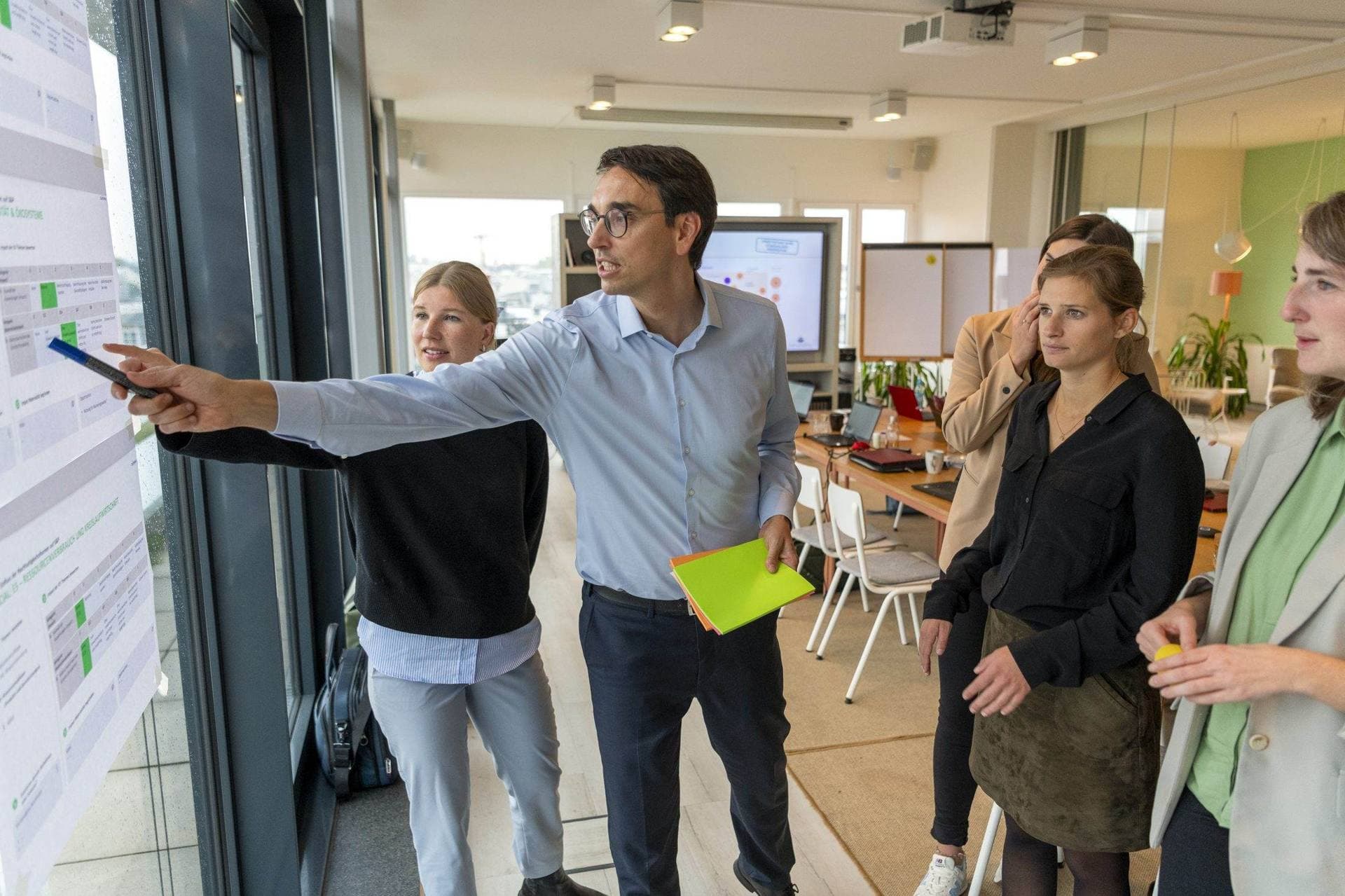
How a utility and infrastructure group tackled questions about its future across company boundaries.
What question is your company facing? Let’s talk about your brief and sensible next steps.
30 minutes, free of charge, by phone or video. Choose your time directly in the calendar.

Let’s talk about your situation and what you want to develop in your organisation.