Skip to content

Leadership in transformation

Leadership development

Leadership development that connects personal learning with real leadership tasks and the development of the organisation.

Leadership development
  • Siemens
  • Porsche
  • Bayer
  • BASF
  • Henkel
  • Sony
  • Metro Group
  • McDonald’s
  • E.ON
  • Dräger
  • Sennheiser
  • Schüco
  • WIKA
  • Currenta

Our leadership development programmes start from what leadership requires in your company. We combine a systemic understanding of organisations, personal reflection and work on real tasks, interlinking the learning architecture with day-to-day leadership.

What you come away with

  • Development goals linked to the role
  • An integrated architecture for learning and application
  • Reflecting together on real leadership tasks
  • Monitoring learning transfer

How we work

  1. 01

    Clarify the brief

    Define the leadership role, development expectations and relevant perspectives.

  2. 02

    Gather feedback

    Compare self-image and how others see the leader, using suitable instruments.

  3. 03

    Try out

    Apply the development plan to real leadership tasks.

  4. 04

    Assess

    Review results and next steps with those involved.

Deriving development needs from the role

What does strategy, organisation and collaboration require? Which leadership tasks should be handled differently in future? These questions set the learning objectives and determine who takes part.

Connecting individual and organisational development

We see leadership as something achieved through the interplay of the whole organisation. So we connect personal skills with communication forums, decision-making processes and shared leadership tasks. What is learned is tried out and evaluated in real situations.

Development works when feedback relates to real leadership tasks and their context.

Linking different ways of learning

We combine self-study, a learning platform, in-person sessions, reflection and evaluation. These building blocks form the basis for an architecture that fits. What is selected, and in which order, depends on the agreed learning and organisational goals.

Book an initial call

Seeing strengths and development areas from several perspectives

The leadership assessment begins with a manager’s concrete task. A 360-degree feedback can compare self-image with feedback from superiors, colleagues, employees and customers. Standardised competence descriptions and a feedback report are available for this. We first clarify with the manager and those responsible which leadership tasks are to be worked on and which perspectives are relevant.

Read more

The result is not read as a label on a person. In a facilitated conversation, differences between self-perception and the perception of others, strengths, risks under pressure and blind spots are discussed. Which procedures are actually used depends on the assignment, suitability and current availability.

Turning development into leadership practice

An individual development plan is drawn up from the evaluation. It specifies which behaviour is to be tried out in which situations and how feedback can be given. To this end, we combine coaching, concrete tasks, feedback and a final evaluation. If a manager takes on a new role, a 100-day programme can be added: stakeholders, positioning, immediate measures and reflection are related to the start in the role.

Read more

For existing roles, other development questions come to the fore, such as decisions across departmental boundaries or dealing with uncertainty. We link personal development with the organisational conditions in which leadership takes place. At the end, participants examine which agreed goals have been achieved and where further learning or a change in the environment is required.

Transfer und weitere Entwicklung beobachten: Erfahrungen aus der Anwendung werden in die gemeinsame Reflexion aufgenommen. Dabei wird auch geprüft, ob die Organisation den Einsatz neuer Fähigkeiten ermöglicht. Ergebnisse können Anpassungen des Programms oder weitere organisatorische Entscheidungen erforderlich machen.

Arbeitsergebnisse: Aufgabenbezogene Entwicklungsziele; Verzahnte Lern- und Anwendungsarchitektur; Gemeinsame Reflexion realer Führungsaufgaben; Beobachtung des Lerntransfers.

The programme name, formats, technology platform and duration are agreed in each assignment.

The leadership assessment follows a multi-stage approach. First, the leadership task is clarified, then feedback is obtained from relevant relationships. Self-assessments and assessments by others can be made visible in a feedback report. The report is discussed with the manager before a development plan is drawn up from it.

It is worth taking a close look at differences: a person may experience an ability as a strength while employees observe something different in a particular situation. This difference is not a judgement, but a question for the conversation. It is also about blind spots and behaviour that can limit a manager's effectiveness.

Development then concentrates on a few concrete tasks. A new leadership position can be combined with a 100-day programme; for an existing role, other experiments and feedback loops may make more sense. At the end, we jointly examine whether the agreed development goals have been achieved. At the same time, we ask whether the organisation offers suitable decision-making scope and opportunities for feedback. Personal development and the leadership environment cannot meaningfully be separated.

Feedback on leadership behaviour can be demanding for the person concerned. Before data is gathered, it is therefore clarified who will see the results, how they will be discussed and what development purpose they serve. In the moderated conversation, concrete situations are sought rather than reading a report only for its highest and lowest scores. From this, the manager chooses a few behaviours that they can try out in their work. Colleagues, employees or superiors can give feedback again later. This sequence of observation, attempt and reflection makes development traceable.

The final conversation examines not only individual behavioural goals, but also whether the manager has received suitable feedback and decision-making latitude in their role.

The leadership assessment links feedback with development. A 360-degree feedback makes visible the differences between self-image and the experiences of superiors, colleagues, employees and, where applicable, customers. These differences are occasions for conversation, not automatic judgements. The evaluation meeting clarifies which leadership task is associated with them and which behaviour the person would like to try out. A development plan needs real opportunities at work, feedback and a later evaluation for this.

Leadership and HR can provide the framework; the manager concerned must help shape the learning path. The result does not show solely in the completed questionnaire, but in whether new ways of acting become possible in relevant situations. The suitability of individual test products must be examined separately for each assignment. The agreed observations are discussed again later so that progress and further development questions remain distinct.

Three variants are available for the assessment. An online self-assessment captures strengths, risk factors and motivators: a person's bright side at their best, their dark side under stress and the inside of the values that guide their actions. It saves time, is flexible and shows professional aptitudes as well as possible reactions under stress. A 360-degree feedback on competencies, career derailers and performance is gathered in moderated workshops. It provides a highly differentiated picture of strengths and development opportunities, reveals blind spots and hidden strengths, and is personally supervised.

The third variant is an online 360-degree feedback on versatility. It looks at two pairs of opposites: assertiveness and fostering personal responsibility, and strategic action and operational efficiency. Someone who can show both sides of a pair is versatile. With only four dimensions, the evaluation makes clear how a strength used too intensively becomes a weakness, and shows tensions and contradictions. Both feedback variants meet with high acceptance because several perspectives are included. In all three variants, a written assessment follows, it is handed over to the manager and their superiors, and a moderated feedback meeting takes place.
Frequently asked questions

What does a leadership assessment look at?

Role-related skills, strengths and development areas and, if needed, risks under pressure. The assessment starts from the leader’s actual role, supported by standardised descriptions of observable behaviour and a feedback report. The transformis 360° feedback concept (2018) attributes 70 per cent of development to demanding assignments, 20 per cent to feedback and 10 per cent to training.

Who gives feedback?

Depending on the brief, line managers, peers, direct reports and, where relevant, customers. A 360-degree feedback compares the leader’s self-image with this feedback. First, we agree with the leader and those responsible which leadership tasks to focus on and which perspectives matter; the instruments used depend on the brief, their suitability and availability.

What happens to the report?

It is interpreted in a facilitated conversation and turned into a concrete development plan. We discuss differences between self-perception and how others see the leader, strengths, risks under pressure and blind spots; the result is never treated as a label for the person. The plan sets out which behaviours will be tried in which situations, backed by coaching, assignments, feedback and a final review.

Is the 100-day programme always part of it?

No. It works best when someone is starting a new role, with stakeholder analysis, positioning, immediate actions and reflection. In existing roles, other development questions take priority, such as decisions across departmental boundaries or handling uncertainty. At the end, those involved review which goals have been met and whether the organisation allows new skills to be used.

In practice

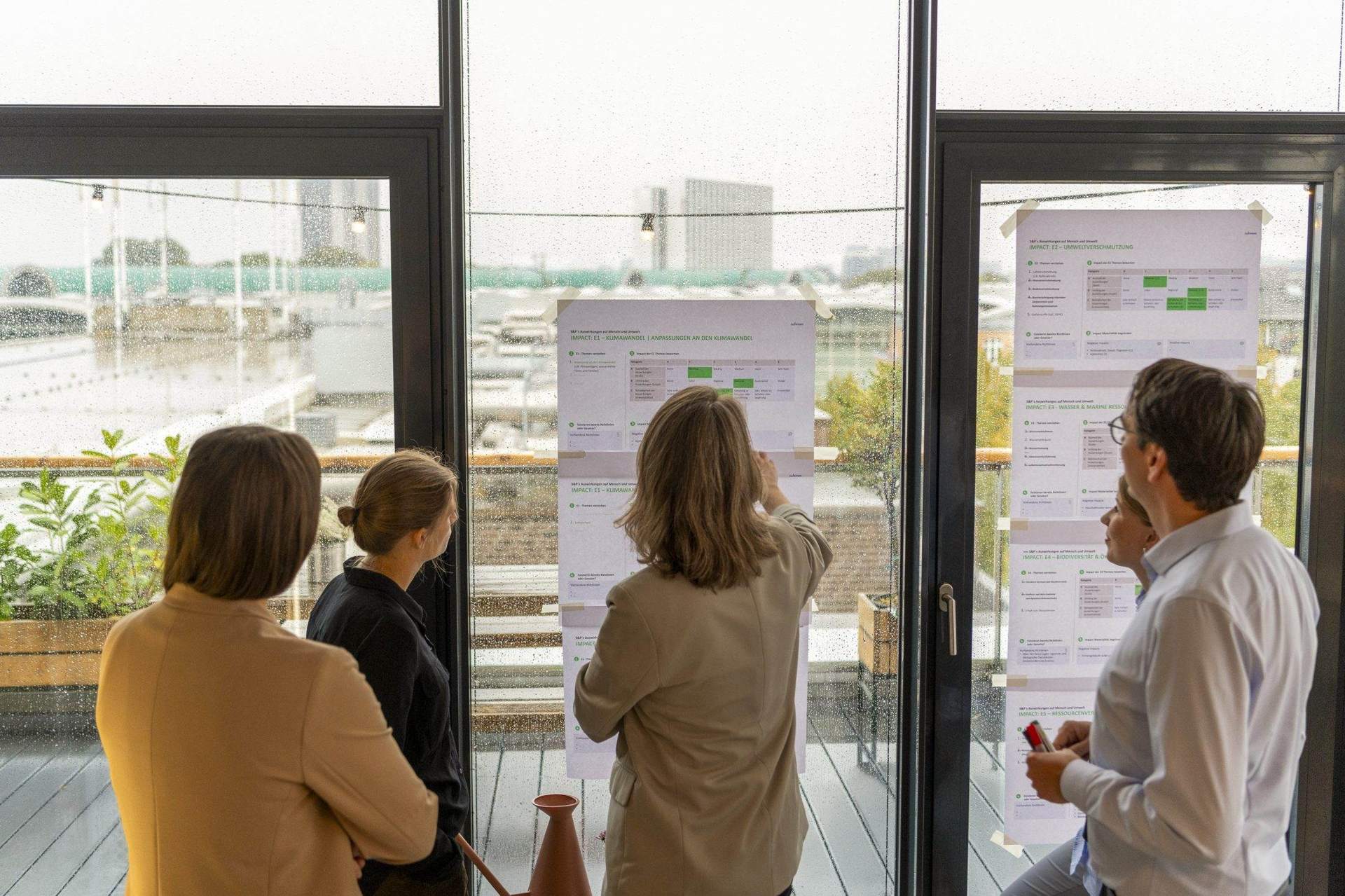
Three people working at pinboards in front of a glass façade

Case study

Logo E/D/E

Developing logistics: combining diagnosis, leadership structure and capability building

A multi-stage change process that moved from vague complaints to new leadership routines.

  • A documented organisational diagnosis and an approved new leadership structure.
  • In the rollout described in part 2, twelve of 13 positions were filled internally.
  • Leadership principles developed together and a leadership handbook informed by pulse-check feedback.
Read case study

Prefer to talk directly?

What decision are you facing? Together, we clarify your situation, the people involved and the right next step.

Dr. Sina Haupt

Dr. Sina Haupt

Head of Leadership competence team | Senior Project Manager

Kira Rempel

Kira Rempel

Senior Consultant and Head of HR competence team

Your initial call

Let’s talk about your situation and what you want to develop in your organisation.

  • Your situation
  • What brings you to us
  • Possible next steps
Book an initial call