White paper
Chemical industry: changing course in rough seas
How mid-sized chemical companies can cut costs, invest and realign their business when difficult market conditions are here to stay. A white paper.
Read moreWhat sustainability means for a company, what ESG regulation and the financial markets require, and how the transformation to a sustainable business succeeds.
Becoming a sustainable company is a question of future viability. This white paper explains the three dimensions of ESG (environmental, social and governance), puts the regulatory requirements for companies and financial service providers into context, and describes the sustainability risks that supervisors and banks take into account. It shows what matters inside the organisation: credible positioning, a network of key people and the commitment of the management board. The sustainability transformation runs in three steps, from the starting point through the transformation concept to implementation. The framework is the multi-level perspective on socio-technical transitions.
The political goal is greenhouse gas neutrality by the middle of this century. So that it can be achieved and protection of the environment through resource-conserving living and business becomes reality, companies in the European Union and in Germany are increasingly being held to account by law. Economic performance, protection of natural resources and social responsibility must go hand in hand so that developments are sustainable in the long term.
Integrating the sustainability dimensions of environment, social matters and governance into the company’s strategy and the corresponding business processes has become an indispensable management task for securing long-term success.
Potential for one’s own company can only be leveraged from the major societal challenges such as climate change, demographic change, urbanisation and digitalisation if the interrelationships between the company’s activities and their significance for society, ecology and the regional and supra-regional economy are considered in an integrated way.
To create transparency and comparability between companies, far-reaching regulatory requirements have emerged. The Corporate Sustainability Reporting Directive (CSRD) puts sustainability reporting on a par with financial reporting and is designed to expand the group of companies required to report.
The EU Taxonomy creates a standard for classifying sustainable economic activities and is capable of strongly influencing investment decisions. The Disclosure Regulation (Sustainable Finance Disclosure Regulation, SFDR for short) aims to create transparency about how sustainability risks and adverse sustainability impacts are taken into account in financial products.
When it comes to advancing the transformation towards greater sustainability at economic and societal level, banks play a decisive role alongside political actors, because they steer capital and money flows. The Federal Financial Supervisory Authority (BaFin) therefore requires banks to assess companies taking sustainability risks into account. This affects the capital market and thus the financing and future viability of companies.
Sustainability is therefore more than a trend. With the dimensions of environment, social matters and corporate governance, it is relevant for securing the future of companies. Convincing sustainable business models are increasingly regarded as an indicator of good management.
The transformation into a sustainable company can be achieved by integrating three dimensions: Environmental, Social and Governance.
Doing business more sustainably means gradually taking on more responsibility for people and the environment. Holistic sustainability management aligns activities within the company and along the value chain with the three dimensions.
A sustainable company integrates environmentally friendly, socially responsible and economically viable practices into its business strategy. Only in this way can sustainability be used as a lever for differentiation, for innovation and for minimising risk.
Sustainability in a company relates, among other things, to managing the impacts of climate change, to processes and products geared towards the circular economy, and to digitalisation in administration. It also includes working conditions, equal opportunities and the involvement of employees in one’s own company and in the supply chain. Finally, it is about corporate culture, compliance and the exclusion of corruption.
In this scope, the transformation into a sustainable company describes perhaps the greatest megatrend of our time.
To create transparency and comparability between companies with regard to ESG, far-reaching reporting requirements have emerged for a growing group of companies. Which companies are required to report, and from when, depends on size criteria such as number of employees, total assets and turnover, and is to be taken from the legal situation in force at the time.
The core of the CSRD is the double materiality analysis. On the one hand, the influence of sustainability aspects on one’s own business activities (outside-in) must be assessed; on the other, the influence of one’s own business activities on sustainability aspects (inside-out). In addition, there is the significance of both perspectives for stakeholders. This assessment must be carried out and documented regularly.
The EU Taxonomy plays a key role in implementing the regulatory requirements. It creates a framework for determining whether an economic activity is to be classified as sustainable. It was initially developed for environmental sustainability.
Companies covered by the CSRD must state to what extent their turnover, their capital expenditure and their operating expenditure are taxonomy-aligned, that is, meet the requirements laid down in the taxonomy and thus make a substantial contribution to climate protection.
The financial market, companies and the environment are closely linked when it comes to transparency and disclosure. The company stands in the middle. Its impact on the environment and society, the inside-out perspective, describes environmental and social materiality. The sustainability risks that act on the company from its environment, the outside-in perspective, describe financial materiality.
Towards the financial market, the company acts through its external presentation, that is, sustainability reporting under the CSRD, the European Sustainability Reporting Standards (ESRS) and the EU Taxonomy. In the opposite direction, the financial market assesses the company, shaped by the requirements of BaFin and by the engagement of the financial markets.
This presentation is based on the European Commission’s Action Plan on Financing Sustainable Growth (2018) and on its guidelines on non-financial reporting with the supplement on reporting climate-related information (2019).
Banks steer capital and money flows. For this reason, the Disclosure Regulation (SFDR) creates transparency about the extent to which banks take sustainability risks and adverse sustainability impacts into account in financial products. Specifically, banks must disclose to end investors to what extent financial products are sustainable. The EU Taxonomy is an essential basis for assessment in this respect.
BaFin also obliges banks to assess companies taking sustainability risks into account. This sustainability regulation affects the capital market and thus the financing and future viability of companies.
In the area of climate and environment, BaFin takes two groups of risks into account. Physical risks arise from extreme weather events such as heatwaves and droughts, floods, storms, hail, forest fires and avalanches. They also include indirect risks: the collapse of supply chains, the abandonment of water-intensive business activities, and even climate-related migration and armed conflict.
Transition risks arise from the shift to a low-carbon economy. They include the costs associated with this shift. They also include the fact that companies that fail to switch to new, future-proof technologies cannot meet the preferences of their contractual partners and the expectations of society.
Physical risks and transition risks are connected. They influence the economy, for example through rising energy and raw material prices, lost assets or operational disruptions. This can lead to falling corporate profitability, more legal disputes and lower property values, and overall to a deterioration of the economy as a whole.
As a result, the financial system is burdened. Financial and credit markets are weakened, and there are underwriting and strategic losses as well as operational risks, which in turn have a negative impact on the economy.
Beyond climate issues, the assessment of risks concerns further environmental and social trends that can contain serious financial risks, such as the extinction of animal and plant species and the loss of biodiversity. This refers to risks whose occurrence can have actual or potential negative effects on a company’s net assets, financial position and results of operations as well as on its reputation. Accordingly, companies must consider sustainability in all three ESG dimensions.
01Physical risks
Extreme weather events such as heatwaves and droughts, floods, storms, hail, forest fires and avalanches.
02Indirect physical risks
Collapse of supply chains, abandonment of water-intensive business activities, and even climate-related migration and armed conflict.
03Transition risks
Costs of the shift to a low-carbon economy; failure to switch to future-proof technologies and thus unmet expectations of contractual partners and society.
04Interaction
The risks burden the economy and the financial system, for example through rising energy and raw material prices, lost assets and operational disruptions.
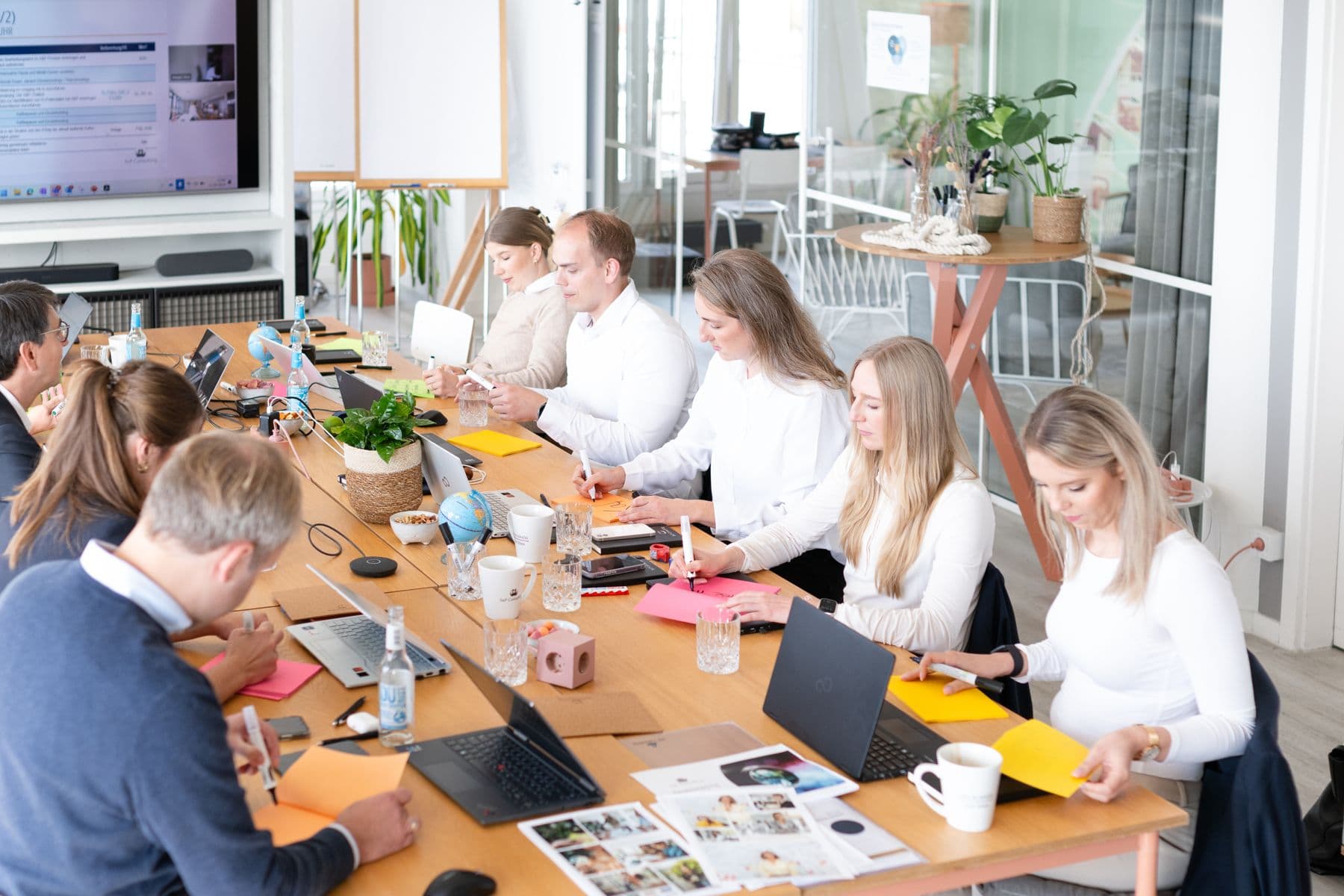
To leverage the opportunities of ESG, it is essential that sustainability is taken into account in all relevant line functions in day-to-day business. Decisive for success are the necessary awareness at management level and the development of a shared target picture from which the key fields of action can be derived.
transformis advises and supports organisations in developing credible and effective positioning internally and externally. What matters is networking different perspectives, that is, using the organisation’s entire system intelligence. This creates a shared picture of the future with which even paradoxical issues can be resolved in close alliance at the top decision-making level.
This creates the basis for authentic communication internally and externally. It also ensures that subsequent decisions are made fully in line with the jointly supported target picture.
In short, three things are needed. First, a positioning on sustainability that is known in the organisation and credible both internally and externally. Second, smart networking of the key people as well as synchronisation of sustainability activities and ongoing initiatives.
Third, the management board must radiate awareness and commitment. Only then will work on the tasks surrounding the key sustainability issues be given the necessary space, and the associated initiatives be actively advanced.
In profound transformations, transformis focuses on so-called third-order change processes. This means that an organisation’s established patterns of change are themselves changed in such a way that the preconditions for the transformation into a sustainable company are created. In this way, solutions are developed together that did not exist before.
Well-designed, modern formats bring together different internal and external perspectives and ensure comprehensive networking.
How a sustainable business model is ensured can be described on three levels: requirements, output and outcome.
The requirements come from three directions. The market demands the fulfilment of customer requirements, accountability when raising capital, securing the future, a sustainable supply chain and the reduction of sustainability risks.
Regulation demands the implementation of the CSRD, achieving alignment with the EU Taxonomy and the fulfilment of statutory due diligence obligations in the supply chain. Society expects compliance with social values and norms, attractiveness as an employer, sustainable use of resources and transparent business conduct.
The output is created in the organisation. Effective sustainability management is established, sustainability initiatives and measures are implemented, and the regulatory requirements are met. The basis for this is a corporate culture that promotes sustainability.
The outcome shows on two sides. On the sustainability side are a sustainability strategy, ESG reporting, sustainable products and services and an enhanced reputation.
On the economic side are liquidity via the capital market, access to markets and end customers, and efficient value creation including partners and alliances. Engagement and enablement connect both sides: in a sustainable business model, sustainability and economic viability support each other.
01Market requirements
Customer requirements, accountability when raising capital, securing the future, sustainable supply chain, reduction of sustainability risks.
02Regulatory requirements
Implementation of the CSRD, alignment with the EU Taxonomy, due diligence obligations in the supply chain.
03Requirements of society
Social values and norms, attractiveness as an employer, sustainable use of resources, transparent business conduct.
04Output in the organisation
Effective sustainability management, implemented initiatives and measures, regulatory requirements met, supported by a suitable corporate culture.
05Outcome: sustainability
Sustainability strategy, ESG reporting, sustainable products and services, enhanced reputation.
06Outcome: economic viability
Liquidity via the capital market, access to markets and end customers, efficient value creation including partners and alliances.
The path to organisational sustainability runs in three steps: establishing the starting situation, developing the transformation concept, implementing the transformation concept. Surveying the starting situation creates a good basis for the transformation concept. The company’s objectives determine how this step is designed: whether it is about ESG reporting, a sustainability strategy or a corporate carbon footprint.
The ESG check provides an overview of the status quo. It determines the current situation and identifies initial fields of action and levers for further anchoring sustainability in the organisation in the three dimensions Environmental, Social and Governance.
The materiality analysis determines and assesses the impacts of business activities on sustainability aspects (inside-out) and the effect of sustainability aspects on the company (outside-in). The most important stakeholders are involved; the stakeholder survey is a separate component of this step. The basis includes the European Sustainability Reporting Standards and relevant market trends.
The result is the sustainability issues that are material for the organisation. They form the basis for getting started with ESG reporting as well as for developing a sustainability target picture and concrete measures.
The environment analysis, also called the ESG market check, determines the current sustainability requirements in the market, relevant trends and developments, and the expectations of the most important stakeholders regarding the service portfolio. Qualitative and quantitative methods are combined for this in order to collect the best possible data basis.
There are different entry points for developing the transformation concept, and in this step too the objectives set the focus. If a sustainability strategy is to be created, the work begins with developing business model options.
If the initial aim is to meet the requirements for sustainability reporting, a sustainability target picture and fields of action are developed. From these, an ESG key figure system and concrete measures are derived in the next step. If carbon accounting is the focus, the work begins with defining the system boundaries and identifying the sources of emissions.
For implementing the transformation concept, an implementation roadmap and suitable structures and processes are developed. The sustainability strategy is made concrete by deriving fields of action and focus projects. For ESG reporting, an ESG key figure system is developed and data collection is supported.
For carbon accounting, support covers estimation, data collection and emissions calculation for Scope 1, 2 and 3. The transformation concept is developed step by step by setting climate targets and gradually expanding the planning of measures. In this phase too, the objectives set the direction.
What distinguishes transformis’s approach is that the knowledge available inside and outside the organisation is mobilised and can feed productively into the respective discussion and decision-making processes. This creates solutions that did not exist before and that fit the organisation’s needs exactly.
Transformation processes of this kind are complex. That is why the substantive, time and social levels are taken into account, and the speed of the individual process steps is steered according to the needs and possibilities of the organisation, without losing sight of the goal. This is consulting in the third mode.
The aim is to enable the organisation to recognise sustainability developments and sustainability requirements early and to address them independently.
01Establishing the starting situation
ESG check, materiality analysis, stakeholder survey and environment analysis.
02Developing the transformation concept
Sustainability strategy based on business model options, sustainability target picture for ESG reporting, or carbon accounting with a focus on the environment.
03Implementing the transformation concept
Implementation roadmap, development of suitable structures and processes, enabling the organisation.
Many of the established criteria by which organisations successfully made decisions for decades are now outdated. When economic, ecological, social, political and technical conditions change, this has significant effects on everyone operating within these conditions.
The present can be described as a transition phase: as a comprehensive change from one socio-technical system to another, brought about by changes that build on each other and influence each other.
The multi-level perspective on the dimensions of sustainable transitions, here following Geels and Schot (2010), traces the broad lines of socio-technical change. It provides a universal framework for the interlocking evolutionary dynamics at different levels of society: the socio-technical landscape, the socio-technical regimes and the niches.
Socio-technical regimes are often highly institutionalised and therefore unable to respond early and appropriately to changes in the socio-technical landscape. Niches, by contrast, are weakly structured and therefore much more agile. Radical innovations therefore often emerge in niches outside the existing regime, then gain in importance and can change the existing regime.
Companies are called upon to recognise these developments with foresight and to include them in their strategy work. In this way, opportunities for their own business model can be recognised and used early and risks reduced. To do this, a company needs smart routines and criteria of observation and evaluation.
ESG stands for Environmental, Social and Governance. Holistic sustainability management aligns activities in the company and along the value chain with these three dimensions.
It assesses two directions: the influence of sustainability aspects on the company (outside-in) and the influence of the company on sustainability aspects (inside-out). The most important stakeholders are involved.
Banks steer capital and money flows and assess companies taking sustainability risks into account. This affects the capital market and thus the financing and future viability of companies.
A distinction is made between physical risks such as extreme weather events, including their indirect consequences, and transition risks arising from the shift to a low-carbon economy. In addition, there are further environmental and social trends such as the loss of biodiversity.
It begins with surveying the starting situation, for example through an ESG check, materiality analysis and environment analysis. The company’s objectives determine how this step is designed.
White paper
How mid-sized chemical companies can cut costs, invest and realign their business when difficult market conditions are here to stay. A white paper.
Read moreWhite paper
The Future Forum is a compact strategy format that helps leadership teams secure or realign their core business in three to six months. A white paper.
Read moreWhite paper
How companies stay able to decide under uncertainty: new basic assumptions, a shared vision of the future and a regular strategy review. A white paper.
Read moreWould you like to apply the content to your company? Let’s talk about your starting point.

Let’s talk about your situation and what you want to develop in your organisation.