
Orientation
Coaching or organisational development: which fits?
Coaching or organisational development? How to tell individual development issues from recurring organisational patterns and choose the right support.
Read moreOrganisational design, silos and working across departmental boundaries.
Which decisions and tasks require reliable collaboration across departmental boundaries?
At which handovers does work regularly stall?
Which goals or responsibilities clash along the way?
Where is there no shared forum in which those involved can decide?
Recurring friction can be traced through specific decisions and handovers. Organisational diagnostics shows which structures and expectations shape collaboration.
An organisation chart does not tell you how tasks, responsibilities and decision paths fit together. Organisational design relates these questions to value creation.
After a merger, different routines and expectations need to be worked through. Organisational development links strategic direction with joint work on roles, decisions and collaboration.
Orientation
Coaching or organisational development? How to tell individual development issues from recurring organisational patterns and choose the right support.
Read more
Orientation
When does external consulting help? How to clarify the occasion, the brief, internal responsibility and the right kind of support for your organisation.
Read more
Orientation
Uncertainty, customer feedback and clear decision frameworks: criteria for choosing agile ways of working that suit the task and your organisation.
Read more
Orientation
Expert consulting, process consulting and the third mode compared: what each form delivers, where its limits lie and when it is the right fit for you.
Read moreFundamentals
Systemic organisational consulting treats companies as social systems and looks at strategy, communication and decision-making together, not in isolation.
Read more
Fundamentals
Transformation as organisational development: how strategic self-renewal connects with structures, culture and leadership.
Read more
Fundamentals
The third mode explained: how the factual, social and time dimensions of a transformation architecture fit together, and why they are planned jointly.
Read moreFundamentals
Ambidexterity meaning and practice: how leaders combine exploitation and exploration to run the core business and develop new business at the same time.
Read more
Fundamentals
Variation, selection and restabilisation: how an organisation keeps working on its future development through strategic self-renewal alongside daily business.
Read more
Fundamentals
How internal facilitation can support groups as they work through problems and decisions, and how it helps build in-house capability to support change.
Read moreFundamentals
The four types of change: crisis management, continuous optimisation, profound transformation and foresighted self-renewal, and what each demands of management.
Read more
Article
How interfaces, decision paths and shared routines change the way we look at silos.
Read more
Article
Leadership as an organisational function: how roles, expertise and the six tasks of the leadership wheel turn uncertainty into shared decisions.
Read more
Article
Waiting times, duplicated work and coordination effort tie up time and resources. How to use them as starting points for developing your organisation.
Read more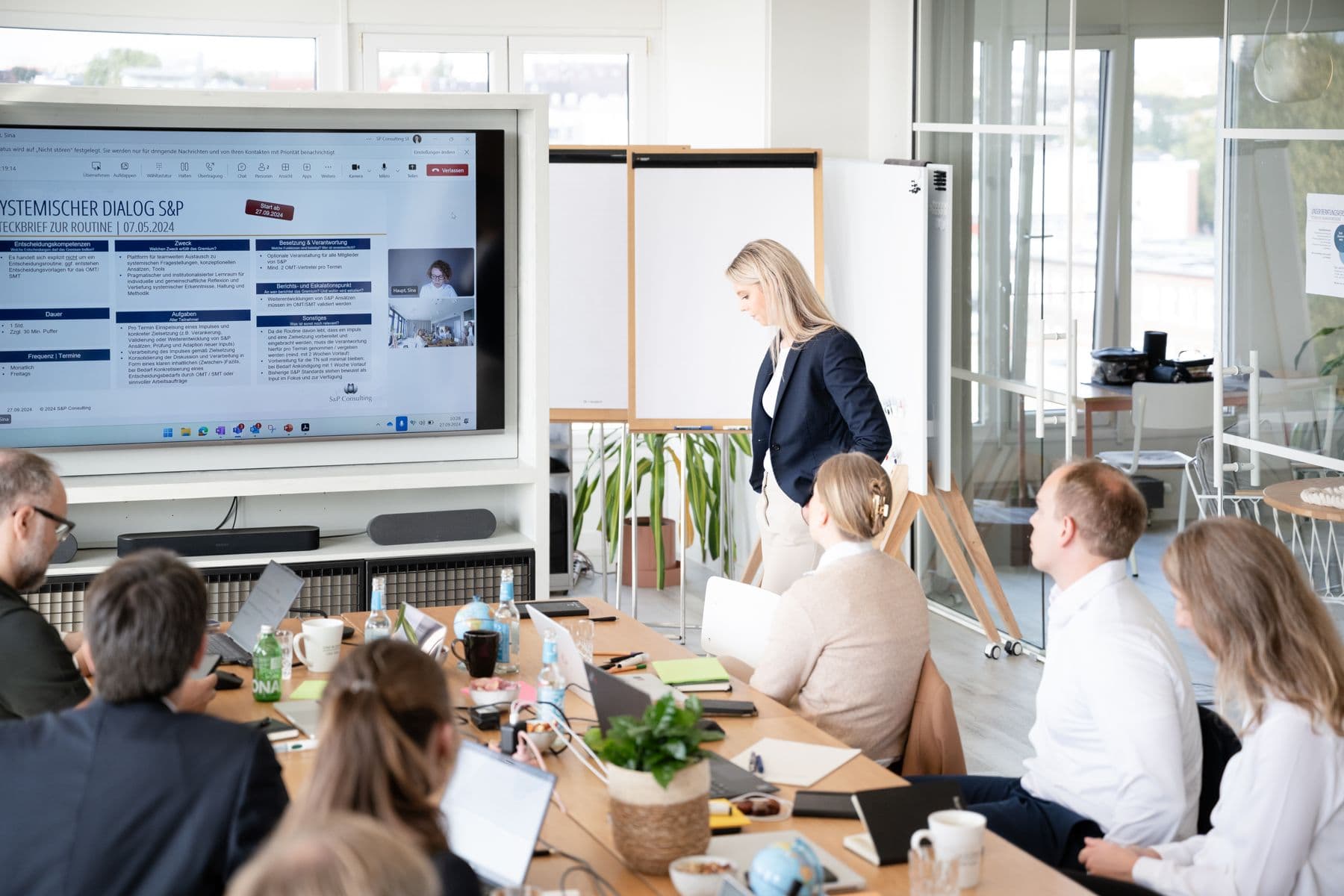
Article
Why training often changes little at work, and how learning goals, opportunities to apply them and leadership can be planned as one development task.
Read more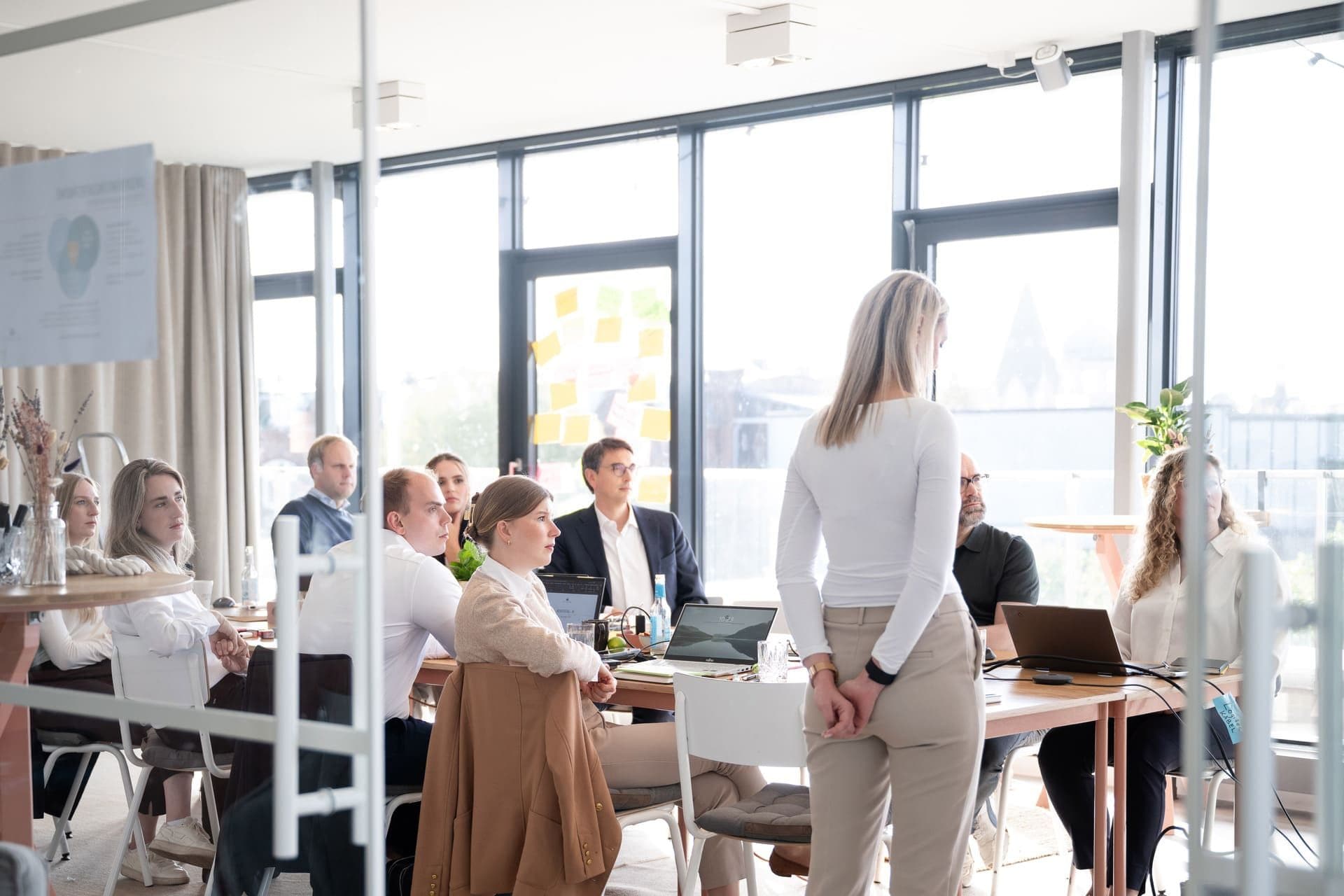
Article
Culture development explained: how strategic goals, lived decision-making patterns and concrete changes to structures and collaboration are connected.
Read more
Article
How leaders organise orientation, participation and feedback during change, and why it matters to separate what has been decided from what is still open.
Read more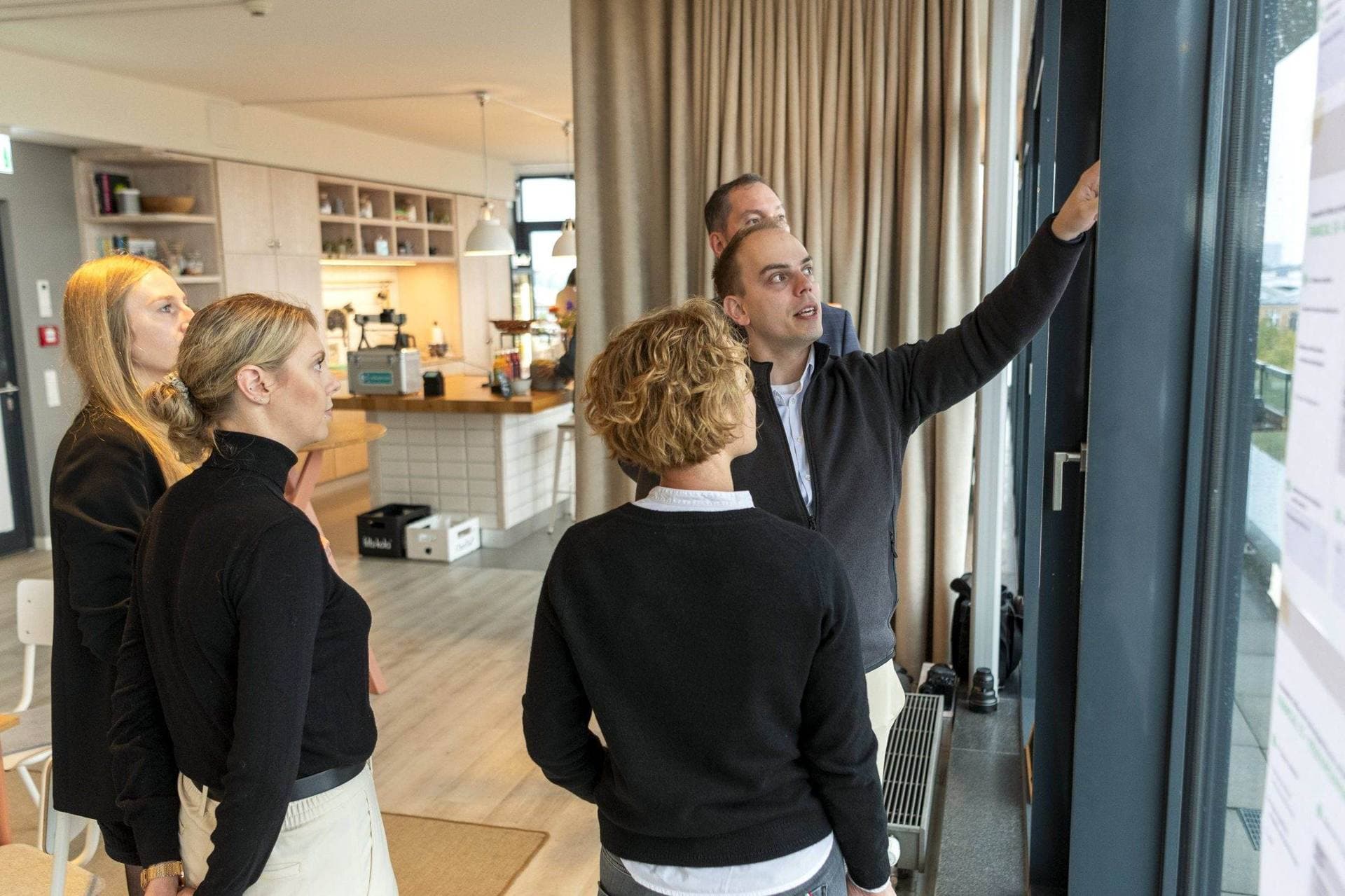
Article
Why change meets resistance: understanding organisational defence patterns and making relevant information workable for decisions taken together.
Read more
Article
Systemic team coaching creates the conditions for high-performance teams: goals, perspectives, process and approaches for better team dynamics.
Read moreArticle
How organisations strengthen customer and service orientation: three practical tools for customer-supplier relationships, both internal and external.
Read more
Article
Systems theory in practice: how leaders stay able to decide in dynamic times through second-order observation, working hypotheses and course corrections.
Read moreArticle
Marcus Wittig, Chairman of the DVV management board, on why DVVision was launched, how it has progressed, its results and what it means for customers.
Read more
Article
How the Cultribute analysis assesses organisational capabilities as they are and as they should be, what the ‘smart line’ shows and how the results feed into strategy, leadership and learning.
Read moreArticle
What a sense of urgency is, why profound change rarely succeeds without it and without an attractive vision of the future, and what comes next.
Read more
Article
When culture change is needed, why culture cannot be ordered, why culture change programmes often fail and which levers they need.
Read more
Article
What mobile learning in companies is, why it does not replace face-to-face formats, which five criteria it should meet and how it is introduced.
Read more
Article
Why, from a systemic perspective, employees belong to the organisation’s environment, how people and operations generate performance together and how the business strategy becomes a workforce and HR strategy.
Read moreThe focus is on structures, decision paths and how the people involved interact. An organisation check, organisational diagnostics and an analysis of the organisation’s characteristics help you understand the starting point.
Organisational development links the task at hand with the way people communicate and make decisions about it. We design transformation and intervention architectures and work on communication during change.
During change, different groups need different information and ways to take part. Together we clarify what has already been decided, which questions are still open and how feedback feeds into the next steps. Communication formats and leadership responsibility are tied to the phases of the project.
Learning architectures, leadership as an organisational capability and forward-looking renewal belong together. The DVVision programme at Duisburger Versorgungs- und Verkehrsgesellschaft shows how communication and decision routines can be handed over to line management.
Value stream management looks at a specific process from the customer’s point of view. Material and information flows, processing and waiting times, and handovers between functions show where effort builds up. From the current process we derive a target state, prioritised improvements and checkpoints for implementation.
Change starts with understanding recurring situations. On that basis we build an architecture that connects topics, roles and sequence. New routines are introduced, reviewed and refined. We help internal owners gradually take over the joint work, and its further adjustment, themselves.
Organisations are highly complex social communication systems whose basic elements are the communication of decisions. They are operationally closed, meaning that in their ongoing activity they orient themselves towards themselves and are thus self-referential. Organisations construct their view of reality in their internal communication. To do so, they use established routines of perception, which means that organisations do not see what they do not see.
Organisations cannot be changed directly from outside through targeted interventions. Within the organisation, external signals are either noted as relevant information or simply ignored. The core goal of organisations is to secure their own continuation.
Organisations are not physical things and cannot be touched. They can only be observed, and from these observations a picture of their peculiarities can be constructed. Organisations form around addressing societal problems whose solution requires the coordinated interaction of many functionaries working in a division of labour, as well as a high input of resources. To fulfil their organisational or business purpose, they build up corresponding structures and routines.
In order to reduce complexity and remain capable of acting, organisations select their relevant environments and develop their own grids for observation and evaluation. An organisation's established routines for dealing with signals from outside are geared towards picking out those signals that confirm the established internal pictures of the environments and filtering out divergent signals.
Our basic hypotheses:
Organisations attend to problems from the past that are currently pressing for a solution
Left to themselves, organisations are preoccupied with themselves. This self-reference reinforces their tendency to design their activities towards their environment from an inside-out logic
In principle, organisations are wasteful with resources if no one interferes
Organisations tend to cling to structures and routines once established, even when they are no longer adequate (principle of path dependency)
Without leadership, the members of an organisation decide for themselves which of their abilities they want to contribute to the organisation and which not
Organisations are fundamentally opaque to themselves. They are therefore required to define precisely those dimensions that allow them to observe themselves appropriately from a performance perspective, and whose evaluation gives them a realistic assessment of their own state. Only this self-created realism provides the basis for all effective leadership processes
Organisations have a number of natural tendencies that lead them into serious problems unless the responsible leaders are able to counteract these tendencies. Organisations hold on to proven logics of success even when these are no longer effective under changed conditions. Past solutions are reflexively applied to new problems; irritations tend to be explained away rather than taken as an occasion for genuine rethinking.
The organisation mainly sees what it already knows. Blind spots remain invisible. Its own patterns of observation and evaluation are rarely questioned; relevant developments are recognised too late or not at all (tendency to normalise the unusual).
Stability secures operations but makes necessary change more difficult. Routines create reliability but also produce inertia. Change has to take place during ongoing operations, competes with day-to-day business and has to find a constructive way of dealing with the unavoidable tendencies towards inertia. Uncertainty, ambiguity and incompleteness are processed inadequately.
Decisions are made as if information were complete. There is rarely a competent way of dealing with the degree of not-knowing that always shapes every decision too. Dealing with complexity requires time, which as a rule is not made available in everyday work. This invariably leads to inappropriate simplification and, in some circumstances, to far-reaching wrong decisions.
Leadership is strongly focused on dealing directly with operational issues and less on challenges that require shared observations and a corresponding reflection on them. It remains unclear by which criteria decisions are made, priorities set and communication conducted, and what is systematically left out.
Contradictory requirements are treated as either-or instead of being productively integrated. Efficiency vs. innovation, stability vs. renewal or centralisation vs. autonomy are played off against each other instead of being consciously addressed. As a result, the goal conflicts that are constitutive for the organisation are not dealt with in a sustainable way (trivialisation).
When it comes to unusual problems, solutions tend to be bought in externally rather than drawing on the organisation’s own intelligence. As a result, internal competence in this area is not built up. Recognised changes are often demanded top-down and directively, without genuine participation in working on them. Pressure creates adaptation but not identification; a shared sense of urgency fails to emerge and sustainable renewal fails.
transformis® is an organisational development consultancy with a systemic approach and a clear focus on structure, processes, communication and decision-making.
We advise and support organisations in designing and developing their structures, processes, ways of working and communication routines so that they fulfil their organisational and business purpose effectively, even under conditions of uncertainty, complexity and ongoing operations.
Our approach:
We develop organisational structures and routines consistently in line with the company's specific purpose and objectives. Not one standard for everything, but structures that suit the strategy, the business model and the organisation's real working logic
We enable organisations to steer themselves rather than relying on permanent external intervention. The aim is not dependence on consulting, but the lasting ability of the respective client system to decide and act
We create temporary structures and project formats for addressing concrete challenges. Topic-specific mandates, roles and decision-making spaces for issues that cannot be resolved in line operations and that sensibly call for external consulting and support
We always think of structural and process change as taking place during ongoing operations. Transformation is deliberately balanced in order to cope well with the demands of such an exceptional state
We ensure that established decision logics, responsibilities and interfaces can be discussed openly, insofar as they are responsible for creating and sustaining the organisation’s problems. Latent ambiguities become workable and the related decisions become connectable
We work with the organisation's established inner logics – not against them
Existing patterns are understood and, where it makes sense, used and deliberately developed further rather than ignored or replaced wholesale
We shape change through dialogue and participation. Change comes about through understanding, participation and meaning; not through coercion or mere directives
When developing an organisational design that fits the strategy and supporting the associated transformation process, the following effects and outputs of our work are particularly important to us:
Ensuring consistent customer orientation
Designing communication structures
Developing tailored learning architectures: learning at the individual level is deliberately coupled with structural changes
Establishing decision-making processes
Managing internationalisation steps at the organisational and leadership level
Building suitable leadership structures, in particular establishing effective management teams
Clarifying decision-making authority and responsibility, roles and tasks
Role descriptions and the associated requirement profiles
Including culture and implicit patterns: premises that cannot be decided (values, beliefs, routines), which significantly shape behaviour, are also taken into account
Mobilising the organisation’s internal knowledge: solutions emerge from within the organisation itself. Consultants structure and frame rather than prescribe content
Dealing with paradoxes and uncertainty: contradictory requirements are not resolved, but handled in a productive, manageable way
Organisations become more effective, more decisive and more adaptable because structures, decisions and communication are deliberately aligned with strategic impact and operational implementation.
Benefits at a glance:The benefit of this practice area is not limited to designing high-performing organisational structures and processes. It also lies in the organisation's ability to continuously adapt its organisational design, its decision-making processes and its forms of collaboration to new strategic requirements. The result is an organisation that can continuously develop and secure its capacity for performance and renewal in the long term.
What speaks in favour of working with transformis® on challenging organisational transformation processes:
The tailored development of a strategy-led organisational design. This means that organisational development starts from the corporate strategy and develops an organisational design that conforms to the strategy, instead of implementing ready-made standard structural solutions. We draw on many years of experience with different types of organisation and industries (e.g. family-run companies, groups, administrative organisations, municipal service providers).
Using the system’s intelligence. Using the system intelligence that already exists in the network, the organisation and the ecosystem. This ensures that the necessary variety of perspectives is taken into account in the solution processes. Solutions emerge from within the organisation, not from external blueprints.
Strong focus on commitment and social dynamics. Professionally supported processes actively involve relevant key players. Organisational solutions are not only sound in content, but also socially compatible. Early commitment significantly increases the likelihood of implementation.
Forward-looking organisational self-renewal. We see organisational development as proactive and lasting learning capability, the central aim of our collaboration, not a one-off project. We have a rich repertoire for dealing with organisational paradoxes and tensions so that they can be used as a resource for development.
Deliberately designed transformation architecture (third mode). The content, social and process dimensions are taken into account simultaneously from the outset. These dimensions influence one another. Change management is an integral part of organisational design, not an afterthought. Transformation processes full of tension are deliberately steered into constructive channels.
Organisational design and leadership system development are two sides of the same coin. Organisational design only becomes effective if suitable leadership structures and leadership processes are developed accordingly, both vertically and horizontally. We ensure that staffing decisions and the development of managers are consistently aligned with these requirements.
We ensure that transformation does not fail because of existing structures, processes and decision-making logics, but becomes lastingly effective through them and their further development.
These services address different tasks. The specific situation determines which of them belong together.
Organisational diagnosis: understand recurring problems by looking at how structures, decisions and culture interact, and choose the right next intervention.
Organisational design: developing structures, roles and decision paths from the strategic task, not from a template.
Transformation architecture for change management: link the topics, the people involved and the timeline of a change process into one workable structure.
Learning architectures that connect individual learning with your organisation’s change tasks and build a learning organisation.
Post-merger integration consulting: build a shared vision, workable decision paths and an organisation that functions as one after a merger or acquisition.
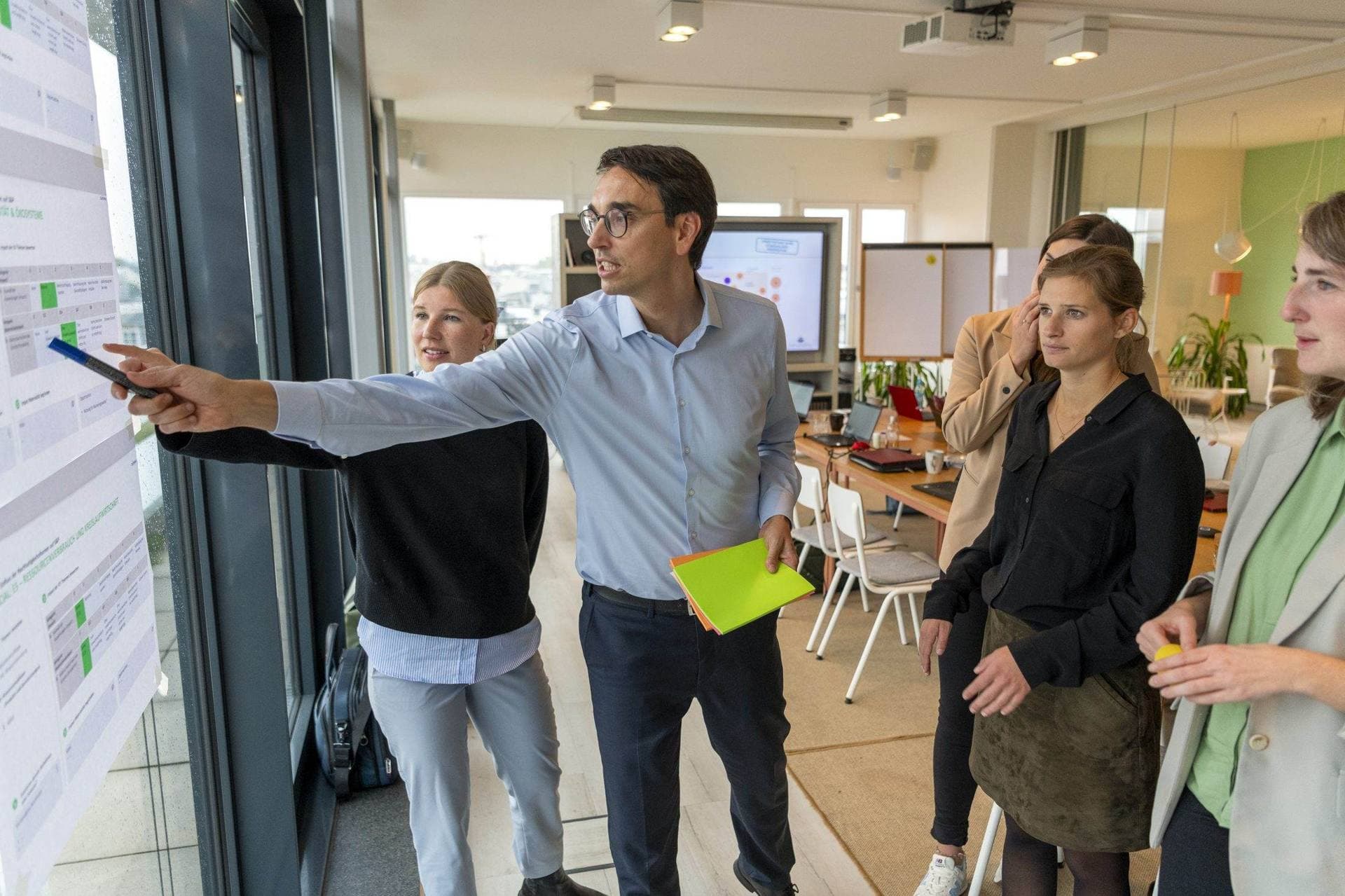
Case study
How a utility and infrastructure group tackled questions about its future across company boundaries.
Background information
19 pages · 2019 · readable online
Read onlineBackground information
11 pages · 2020 · readable online
Read onlineSpecialist article
21 pages · 2019 · readable onlineDr. Reiner Blank, Robert A. Sedlák
Read onlineBackground information
15 pages · 2018 · readable online
Read onlineWhat question is your company facing? Let’s talk about your brief and sensible next steps.
30 minutes, free of charge, by phone or video. Choose your time directly in the calendar.
Let’s talk about your situation and what you want to develop in your organisation.