Skip to content

Organisation in transformation

Transformation architectures

Transformation architecture for change management: link the topics, the people involved and the timeline of a change process into one workable structure.

Transformation architectures
  • Siemens
  • Porsche
  • Bayer
  • BASF
  • Henkel
  • Sony
  • Metro Group
  • McDonald’s
  • E.ON
  • Dräger
  • Sennheiser
  • Schüco
  • WIKA
  • Currenta

Large-scale change needs a structure that lets the organisation work on its future while continuing to operate. A transformation architecture sets out which topics are handled in which working and decision-making formats, giving change management a clear frame.

What you come away with

  • An agreed structure of topics and roles
  • A clear sequence of work and decisions
  • A prepared handover to internal owners

How we work

  1. 01

    Clarify the brief

    Discuss why change is needed, its goals and its limits.

  2. 02

    Design the architecture

    Put topics, participants, formats and decision points in sequence.

  3. 03

    Work through

    Tackle concrete tasks and conflicts with key players.

  4. 04

    Adjust course

    Review reactions and adjust the next stage.

Connecting content, people and timing

The third mode brings three dimensions together: what needs to be worked on? Who needs to be involved, and in what role? In what order does the joint work make sense? These questions are applied to the specific assignment.

Preparing working formats and decisions

The core team, management and others involved get the right forums for diagnosis, options and decisions. Facilitated sessions and jointly agreed minutes make progress transparent. Each next step is prepared using what has been learned so far.

A transformation architecture sets a direction and stays open to what the organisation reveals along the way.

Enabling the organisation to carry on

We support the introduction of new routines and reflection on how they work. Along the way, we clarify which tasks can be taken on internally and which capabilities need to be built for that. The architecture is adjusted as the organisation learns.

Book an initial call

Preparing for second-order change

We distinguish everyday adjustments from a transformation that affects established rules, self-image and cooperation. A detailed final plan cannot fully pin down such processes. We therefore clarify with the responsible management what necessity is seen for the change, which goals are viable and where uncertainty remains.

Read more

The architecture describes the sequence of diagnosis, joint decisions, participation, communication and reflection. It does not only involve top management. Key players from the areas affected contribute knowledge about actual workflows and possible side effects. Only then can differences between the agreed goal and the lived organisation become visible. The architecture must provide enough orientation for people to act, while leaving room to respond to insights from the process.

Maintaining the architecture throughout the transformation

An organisation’s inherent logic and reactions cannot be predicted like a technical project plan. We therefore agree on routines for observation and decision-making: which signals show that an intervention is connecting? Where do conflicts arise between areas, who decides on adjustments and how are they communicated? Those involved work on concrete tasks while the leadership team holds the overarching direction.

Read more

A published case study from a utility and infrastructure group shows multi-stage transformation work; its results are case-specific. A good architecture also makes visible what has been decided and what remains open. It is a working tool for those responsible that is carried forward on the basis of actual developments.

Arbeitsergebnisse: Abgestimmte Themen- und Rollenstruktur; Nachvollziehbare Arbeits- und Entscheidungsfolge; Vorbereitete Übergabe an interne Verantwortliche.

The architecture gives the process direction. It cannot predetermine the outcomes of a complex change process.

Transformation is a second-order change. It does not merely intervene in individual processes, but calls into question the rules by which the organisation has so far managed its tasks. That is why leadership can set a direction, but cannot determine the entire course in advance like a technical installation. In the architecture, we distinguish between a clear goal, workable stages and open questions.

At the start, it must become visible what necessity those involved see for the change. The question, in essence, is what hardship needs to be averted. Without this shared perception of the problem, new structures remain a formal decision. In the following stages, managers and key players work on concrete tasks while paying attention to reactions from the organisation. Different areas may be at different points in the process at the same time.

The architecture therefore needs suitable communication and learning formats that do not merely announce decisions, but take up their effects in everyday work. Reviews examine whether the goal still holds, which intervention was helpful and which unintended consequence has arisen. The organisation thus remains capable of acting, even though the next step is refined on the basis of the experience of the previous stage.

The architecture also records in which formats those affected work on the change themselves. A leadership meeting is suitable for decisions on direction, but not for exploring all the consequences in work processes. That requires people with knowledge of the day-to-day interfaces. The results of this work are fed back to the responsible leadership. A subsequent stage is only planned in concrete terms once it is clearer what impact the previous one had. The process thus remains manageable without denying the uncertainty.

Those responsible record which observation should trigger a new decision. This agreement provides orientation even when the course is open.

Change is a sequence of interconnected spaces for work and decision-making. A transformation architecture therefore does not merely set dates. It clarifies which questions are dealt with in the leadership circle, which with the areas affected and which in operational work. Feedback is needed between the formats: observations from piloting and everyday work must reach the place where decisions on direction are made. Conversely, decisions must be translated into concrete tasks for those involved.

The architecture also keeps open which assumptions will be re-examined along the way. Stages can thus be adjusted when new insights emerge. The result is a manageable framework for joint work, not a rigid script for every organisation. Who is responsible for a stage and who decides on its results is explicitly named for each phase.

A simple tool for setting an organisation in motion is the change story. It answers three key questions. Why is the change needed, why now, and what happens if nothing changes? What should change: goals and metrics, way of working and business model, processes and structures, roles and behaviours of each individual? How does the change unfold, who is responsible for what, and what are the first steps? A symbol and a motto condense the answers. One energy company chose the compass, which provides orientation even when the path changes.

Following Nagel and Wimmer, the dramaturgy of a fundamental, genotypic transformation follows seven steps. First, awareness of urgency is broadly anchored, then a jointly accepted perspective for the future is created. This is followed by detailed design with change priorities, timing and a master plan, and by implementation, in which successes are stabilised and course corrections made. The overall process is then evaluated and the capacity to learn increased. The organisation proactively faces new challenges and continuously tests the inherent dynamics of its operational processes for effectiveness. The arc of tension is carried by two poles: the push force “away from” and the pull force “towards”.
Frequently asked questions

Why isn’t a project plan enough for transformation?

Transformation touches how the organisation fundamentally works; reactions and new insights change the steps required. We distinguish everyday adjustments from second-order change, which affects established rules, self-image and collaboration. A detailed master plan cannot pin down such processes; the architecture provides direction and stays open to what the organisation reveals along the way.

Who designs the transformation architecture?

The leadership responsible, together with relevant key players and expert support. Key players from the affected areas bring knowledge of how work actually gets done and of possible side effects; only then do gaps between the agreed goal and the organisation as it is lived become visible. The leadership team holds the overall direction while others work on concrete tasks.

What is defined in advance?

Goals, participation, formats and decision points, as far as the starting situation allows. The third mode brings three dimensions together: what needs to be worked on, who needs to be involved and in what role, and in what order the joint work makes sense. Facilitated sessions and jointly agreed minutes make progress transparent.

How is the process adjusted along the way?

In regular reviews, observations and feedback are turned into new decisions: which signals show that an intervention is taking hold, where are conflicts arising between departments, and who decides on adjustments? In the DVVision programme, the formats were prepared, introduced with facilitation and then handed over to line management; reviews from 2023 are documented.

In practice

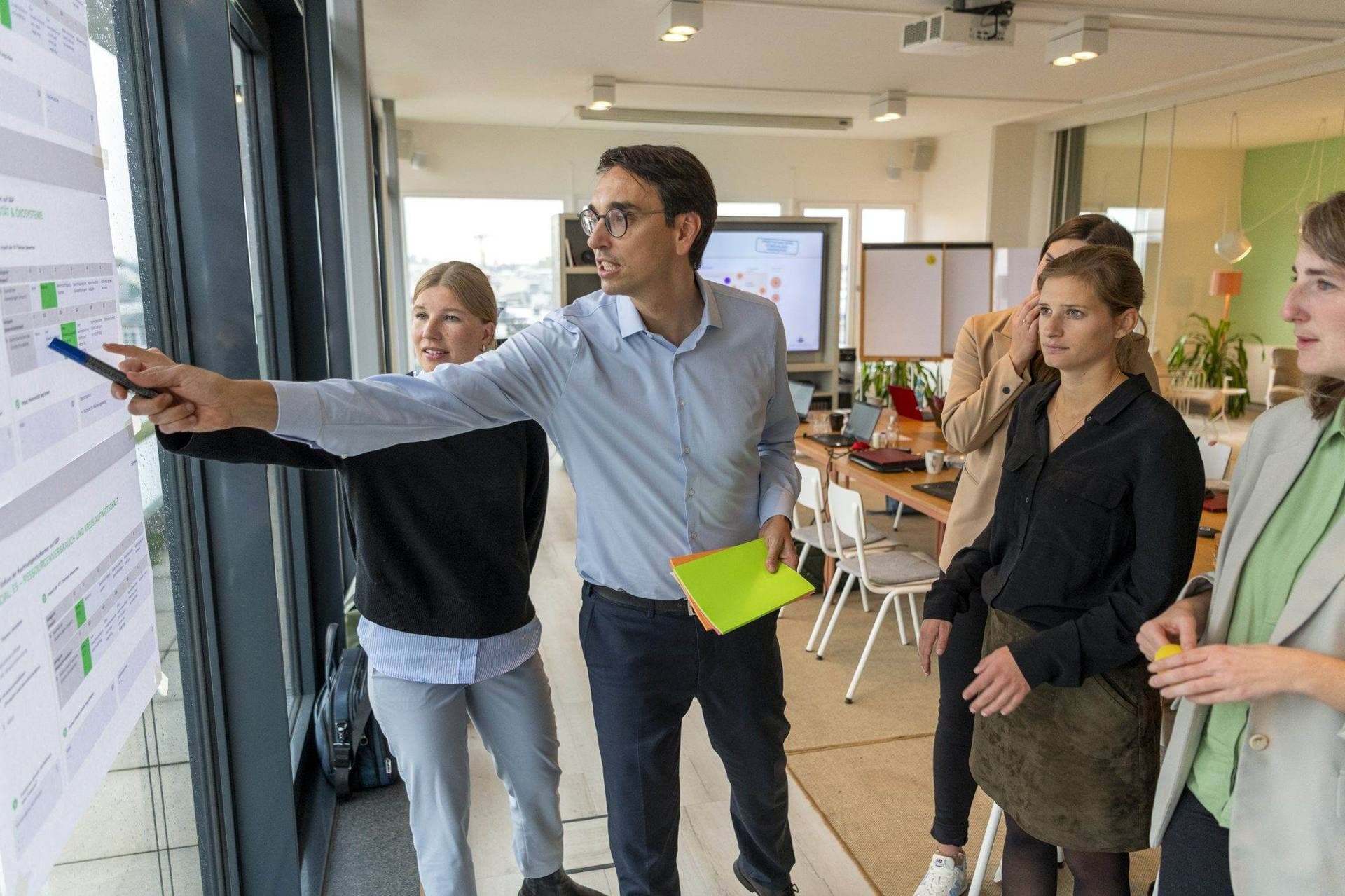
transformis consultant pointing at a wall while the team looks on

Case study

Logo DVV

From efficiency programme to forward-looking organisation

How a utility and infrastructure group tackled questions about its future across company boundaries.

  • Leadership, feedback and decision formats introduced at group and topic level.
  • The programme continued with digital participation formats during the pandemic.
  • Reviews documented in 2023 and a clearer division of roles between line management and corporate development.
Read case study

Prefer to talk directly?

What decision are you facing? Together, we clarify your situation, the people involved and the right next step.

Eva Scholz

Eva Scholz

Senior Consultant | Head of Organisation competence team | Business mediator

Your initial call

Let’s talk about your situation and what you want to develop in your organisation.

  • Your situation
  • What brings you to us
  • Possible next steps
Book an initial call